Fascinating Lists!

Showing posts with label exaggeration. Show all posts

Friday, October 23, 2020

Mark Twain's Tips and Techniques of Humor

 Copyright 2020 by Gary L. Pullman


The McWilliamses Stories


Over a period of thirty-seven years, Mark Twain published three short stories about a married couple named the McWilliamses. Caroline (later, Evangeline—did her husband remarry?) is emotional, superstitious, argumentative, and gullible; Mortimer is rational, put-upon, long-suffering, and henpecked. Foils to one another, the spouses' characters, as well as the incidents in which they become involved, provide the fodder for Twain's humorous treatment of them.


The first story, “Experience of the McWilliamses with Membranous Croup,” was published in 1879; the others, “Mrs. McWilliams and the Lightning” and “Mrs. McWilliams and the Burglar Alarm,” followed in 1892 and, posthumously, in 1916, respectively.


“Experience of the McWilliamses with Membranous Croup”


In the first of these stories, Mortimer is relating his and Evangeline's experience with membranous croup, “an acute obstructive laryngitis in young children, usually between the ages of three and six.” (The Free Dictionary by Farlex). Characterized by “a high-pitched cough and difficulty in breathing,” the condition can be caused by either bacteria or a virus ((The Free Dictionary).


The story starts with what appears to be a reference to an incident unrelated to the ailment: Mortimer suggests that their daughter ought not to be “chewing” a stick of pine. His comment prompts an argument from Evangeline for no other reason, according to Mortimer, than the fact that she, like married women in general, “cannot receive even the most palpably judicious suggestion without arguing it.” As evidence to support her view that the chewing of wood, in fact, has medicinal value, Evangeline references the statement of unidentified “doctors” who “all say that the turpentine in pine wood is good for [a] weak back and the kidneys.” When Mortimer presses her on this astonishing declaration, he learns that their child is not afflicted with either condition and further, that Evangeline never implied any such thing.
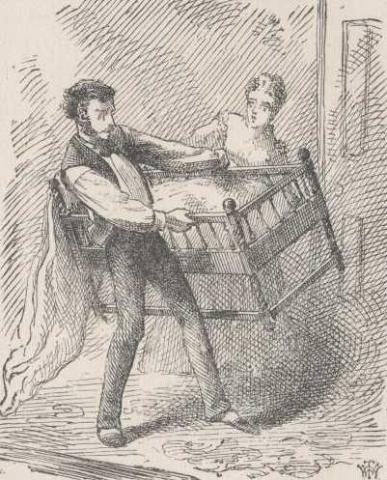


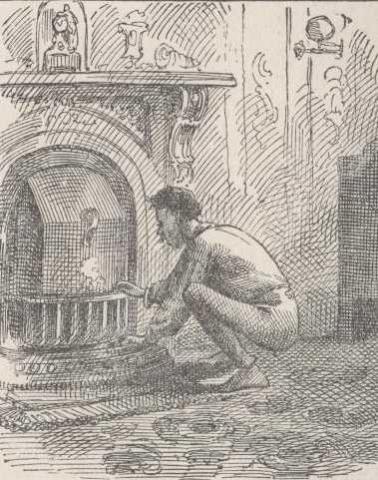
Like the situations in Twain's other McWilliamses stories, this one establishes a situation that lends itself to repetitions of behavior that are but variations upon themselves, as the couple take extraordinary and absurd measures to protect the health of their children, the ailing Penelope and their baby, moving the crib in and out of the nursery, nearer and farther from the fire in the couple's bedroom fireplace, adjusting the temperature of their room up and down, dismissing and recalling the nurse, and Caroline's awakening Mortimer from his sleep to carry out a series of absurd actions related to her nearly hysterical concern for their children. Through such repetition, both in this story and in the other two of the series, Twain extends the narratives' opportunities for humorous treatment, the humor resulting as much from situations involving such repetition of actions as from the opposing traits of the couple's characters.


During the course of the story, Twain employs a number of techniques, many of which are also used in his other McWilliamses stories:


Irony and exaggeration: In response to Caroline's refusal to concede the validity of his logic that the pine wood stick that Penelope chews is not of any nutritional or medicinal value, Mortimer says, “Say no more, my dear. I now see the force of your reasoning, and I will go and order two or three cords of the best pine wood to-day.”


Simile: “sleeps like a graven image”


Comparison: “you know no more what you are talking about than the child unborn”


Misdirected concern: Caroline is more concerned about the condition of her furniture and the family's cat than she is that of Mortimer.


Irony: Caroline insists that Mortimer sleep, letting her take care of Penelope and the baby, but she keeps waking him to ask that he undertake another useless task


Redundancy: “I did not finish, because I was interrupted.”


Irony, through impossibility: “he must come, dead or alive.”


Irony through motive: “Very few married men have such an experience as McWilliams's and so the author of this book thought that maybe the novelty of it would give it a passing interest to the reader.”


Situational irony: Penelope's condition is not the result of the membranous croup, after all, the doctor determines, but of her having swallowed “a bit of pine,” from which she “got some little slivers in her throat.”


“Mrs. McWilliams and the Lightning”


My personal favorite of the three, “Mrs. McWilliams and the Lightning,” is based on the wife's fear of lightning. Now known as Evangeline, Mrs. McWilliams awakens her sleeping husband with her panicked shouts of “Mortimer! Mortimer!”


The story makes good on Mortimer's claims, at the outset of the narrative, that his wife's “fear of lightning . . . . is something pitiful to see.”


As in the previous McWilliamses story, the wife is emotional, superstitious, argumentative, and gullible, while Mortimer is rational, put-upon, long-suffering, and henpecked. Only the name of the wife differs in regard to the characters; children are mentioned, but they play no substantial part in the plot.


Evangeline, who does her own share of arguing, all Mortimer seems to do, in response to her claims and her concerns is to “argue it, and argue it, and argue it!” Of course, in doing so, from a logical point of view, he is correct. He is right, for example, that a man cannot “be ashamed when he is asleep.” He is right that swearing does not cause lightning, and he is right that saying “confound it” is not swearing. He is right that ;light does not attract lightning. He is right that not having said his prayers does not cause lightning—or, for that matter, the past occurrences of earthquake and yellow fever that Evangeline blames on his swearing. He is right that his standing in front of their fireplace cannot result in lightning. Nevertheless, his reasoning does not win the argument; Evangeline remains persuaded, because of her readings of esoteric texts, that her husband is wrong and that his behavior is, in effect, a lightning rod that could bring destruction down on them both.


Evangeline's retorts to Mortimer's rational appeals show the tactics she uses to manage and subdue her husband; she charges him, directly or indirectly, with shame, carelessness, recklessness, profligacy, argumentativeness, irreverence, irrationality, and willful ignorance. Although it may be that he does not accept the validity or justice of such criticisms, Mortimer seems more concerned with allaying Evangeline's fears than with winning his argument, which suggests that he loves her, despite her eccentricity, just as her expressions of concern for him and their children implies her devotion to him and their family.


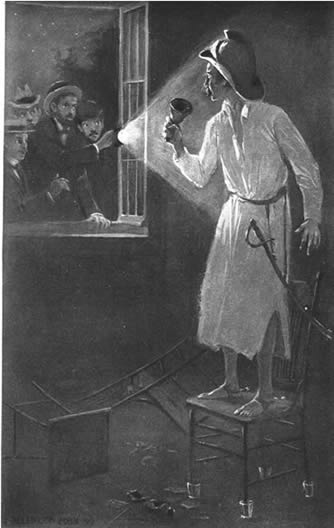
Another source of the humor in this story is Evangeline's attempt to translate an esoteric German text that is clearly incomprehensible to her (and to Mortimer). Believing the book to offer guidance concerning how to deflect lightning, she orders Mortimer to outfit himself in metal objects: his fireman's helmet, his military saber, and his spurs, and to ring their dinner bell, all while standing on a chair. The ringing of the bell causes his neighbors to appear, demanding to know “what in the nation is the matter here?”


The story's punchline comes as the neighbors notify Mortimer that the lightning and thunder he and Evangeline have perceived is, in fact, merely the sound and the flashes of the cannon fire celebrating Garfield's nomination for president. Outside, he is told, “It is a beautiful starlight night.” Due to his wife's superstition and fear, Mortimer has become the laughingstock of the neighborhood and appears himself to be superstitious and fearful.


This story also uses repetition ans a means to both extend the humor and to create a variety of humorous effects. However, this time Twain's use of repetition seems more sophisticated, allowing a greater diversity of sources of information that he can use to produce humorous observations and descriptions, such as science, superstition, rationality, emotionalism, religious beliefs, skepticism, pseudoscience, marital relationships, “book-learning,” private vs. public conduct, personal beliefs, and social and political influences.


In the course of the story, Twain uses these specific techniques to effect humor:


Ironic juxtaposition: “a woman . . . could face the very devil himself—or a mouse”


Concealed humor: Twain tucks humorous observations away among seemingly serious statements, the more to surprise his readers.


Mutual foils as the major source of conflict: a rational husband and an hysterical wife


Superstitious beliefs based on books: “all the books say that . . . .”


Mistaking correlation for causation: cursing causes the flash of lightning that immediately follows Mortimer's “swearing”


Verbal irony: “absolutely at the mercy of Providence”


Simile: “as dark as the inside of an infidel”


Repetition: lightning flashes and thunderbolts allow the extension of the humorous situation through variations of wit and humor; additionally, the husband's alleged profanity has caused not only the current thunderstorm but previous occurrences of earthquakes and yellow fever


Situational irony: a superstitious and irrational wife charges her husband with irrationality, and his actions (lying in bed, standing before an “open fireplace,” “swearing,” standing near a window, approaching a door, standing close to a wall, lighting a match, donning his pantaloons, failing to say his prayers, singing, admitting a draft of air into the bedroom, turning on water, failing to order a feather bed) attract lightning 


Categorical absurdity: the wife regards the use of the word “blessed” as an instance of profanity


Personification: lightning is a “marksman”with bad aim, yet


Dubious cause-and-effect relationships: the wife's shutting herself inside the boot-closet with a book causes her husband to enjoy “a moment's peace”


Ridiculous, unnecessary action causes destruction: chasing a cat destroys $400 worth of furniture


Complex process with ludicrous goal results in absurd actions and husband's becoming a laughingstock


Ignorance compounded by arrogance: The McWilliamses' inability to understand a book written in a foreign language results in ad-libbing ridiculous “translations”


Mistaken effects: cannon fire, not storm, causes effects perceived by the McWilliamses as lightning and thunderbolts


Preliminary, apparent punchline trumped by actual, climactic punchline: not only is Mortimer a laughingstock (preliminary, apparent punchline), but he is also mistaken about the apparent cause of the “lightning” (cannon flashes) and thunder (cannon fire) (actual, climactic punchline)


“Mrs. McWilliams and the Burglar Alarm”


In “Mrs. McWilliams and the Burglar Alarm,” Twain uses the same structure of repetition to milk the situation of its humor. Despite the presence of an expensive, sophisticated burglar alarm, burglars repeatedly burglarize their house. Repeated repairs and adjustments to the burglar alarm merely make the situation worse or introduce new problems. First, the alarm fails to prevent burglaries; then, adjusted (a huge gong is added to the contraption), the alarm works too well, awakening the entire household every time the cook starts the day at five o'clock. In fact, it works so well, it literally wakes the dead. Another repair, due to a series of false alarms, results in so many burglaries that the residents no longer respond to the alarm, surrendering the run of the house to the thieves. The burglar alarm company seeks to remedy this problem by replacing the burglar alarm's clock every three months, which is not only expensive (as all the previous repairs have been), but each effort is “always a failure.”


This story features the following uses techniques:


Spurious cause and effect: “we found we had a little cash left over, on account of the plumber not knowing it.”


Irony through contrasting motives: “I was for enlightening the heathen . . . .[the motive sounds noble], for I was always unaccountably down on the heathen somehow” (but it is really base).


Definition: “whenever I want a thing, and Mrs. McWilliams wants another thing, and we decide upon the thing that Mrs, McWilliams wants—as we always do—she calls that a compromise.”


Punchline: The burglars finally steal the burglar alarm itself.


Play on words: “swear at—sear by, I mean.”


Riff on “summer”: “They [alarm firm workers] promised to have the whole thing finished in ten days. They began work, and we left for the summer. They worked a couple of days; then, they left for the summer. After which the burglars moved in, and began their summer vacation.”


Personification: clocks “would take it [the burglar alarm] off again as soon as your back was turned”


Verbal irony: “those things [burglar alarms] are made solely in the interest of the burglars”


What Could Go Wrong?


One theory of humor finds the source of humor in situations in which a character perceives that something is wrong. Obviously, Twain takes this approach in his McWilliamses stories. Being struck by lightning may not be funny, but as Twain shows, being hysterical about the possibility, which is fairly remote, can be hilarious. What's “wrong” isn't the lightning itself (which, in fact, in the story, never actually occurs), but the irrational fear of it and the behavior that such fear produces. “Mrs. McWilliams and the Lightning” is an account of the multiple results of such hysteria. Twain uses the same approach in his other two stories: In “Experience of the McWilliamses with Membranous Croup,” Evangeline is terrified that her daughter and baby may die from the disease, and her fear fuels the story's humorous effects, as she puts Malcolm (and the rest of her household) through its paces in an effort to save her children, who, as the doctor reveals at the end of the tale, never were at risk, since neither Penelope nor her sibling actually had the membranous croup or any other sickness. “Mrs. McWilliams and the Burglar Alarm” uses the same formula, but, this time, it is an object, more than the characters of the story, that goes wrong, the burglar alarm failing to work at all, working too well, or working at inappropriate times. If such an approach works for Twain, it could work for others, provided, of course, they have Twain's considerable, perhaps unparalleled, gifts as a humorist.


Friday, November 22, 2013

How to Write a Parody the "Mad" Magazine Way


copyright 2014 by Gary L. Pullman


The way that Mad magazine develops a parody is to use a set of conventions that is common to all their satires of motion pictures, television series, and programs associated with similar audiovisual media. Each of these conventions include the absurd, so that object of the parody is ridiculed at every opportunity and in a variety of ways. In the process, through text and imagery, the parody makes frequent allusions to other television shows or artifacts of popular culture, which, ironically, has the paradoxical effect of grounding the parodied program in reality while, at the same time, emphasizing its fictional nature. Finally, the parody also often purposely confuses the lives of the fictional characters with those of the actors who portray them, further maintaining, while simultaneously differentiating, fact and fiction.

The parody begins with an introduction to the program that is being parodied. This introduction typically identifies the program's basic theme, or concept, and relates it to an ostensible purpose that is implied by the effect that the program has had on its medium, audience, or some other objective element. Often, the program's basic storyline is ridiculed, and the main actor—or the character whom he or she plays—is misrepresented in some manner—for example, his or her intentions may be misstated. These conventions are discernible in the following introduction to the magazine's parody of Buffy the Vampire Slayer television series:

Every generation there is a Chosen One [concept]. A girl with three names whose destiny it is to revive a notorious box-office flop as a successful TV series [ostensible purpose]. For seven years she has rescued her supporting cast from melodramatic perils and lame plot twists [basic storyline]. But, now, in their time of greatest need, she will abandon them to pursue a feature film career of nauseating romantic comedies and abhorrent big-budget sequels [misrepresentation of main character's intent]. This girl is. . .

Using absurd surrogate names, the characters, lined up vertically, one after another, as if standing in a police line-up, then introduce themselves, speaking directly to the reader, as if each were soliloquizing before a camera; typically, their address identifies ironies or absurdities in their characters, their roles, or the series' conventions.

I'm Busty Bummers, and even though I'm 35, I'm still in my first year of college. I suffer from a rare aging disorder called “90210 syndrome!” [Buffy Summer's introduction pokes fun at the incongruity of a woman playing a character who is over twenty years younger than she, a convention common to television shows that feature supposedly teenage or young adult characters, such as 90210.]

I'm Pillow. I used to be a mousy computer nerd, but now I'm a mousy witch. [This quip ridicules the stereotypical nature of Willow Rosenberg as “mousy” and suggests that the show's assignment of a new persona to her, that of witch, has not made the character any less stereotypical: she remains as “mousy” as ever.]

I'm Busty's little sister YAWN. I get blamed for this show jumping the shark. But it's not my FAULT! Give me my own SPIN-OFF and I'll prove I'm a GREAT character! [This introduction includes fan criticism of the Dawn Summers character's ruination of the series—many fans considered her character not only unnecessary and unrealistic, even in a fantasy series, but supremely annoying as well; the introduction also alludes to the Buffy spinoff Angel, starring David Boreanaz. The words in capital letters imitate the character's tendency to whine.]

I'm Xanadu and I used to be the comic relief. Now I just sit around and get fatter every episode. [The character, Xander Harris, did provide much of the show's “comic relief” before writers sidelined him much of the time, as the show took on a darker tone, and the actor, Nicholas Brendon, who played him did gain some weight, a fact that the parody also addresses, suggesting that the character's relative idleness and the actor's weight gain are related to one another, the former causing the latter. The parody's rechristening of Xander as "Xanadu" incorporates an allusion to the fantastic world of Samuel Taylor Coleridge's poem "Kubla Khan," thus juxtaposing the popular culture of the television series to the classic culture of which Coleridge's poetry is part, which has the effect of further highlighting the absurdity of the television show.]

I'm Spoke—I'm an edgy vampire [again, a cliché is savaged] who has a love/hate relationship with BUSTY [a trite, melodramatic situation, involving a May-December, Romeo-and-Juliet relationship, is ridiculed]. After this show ends, at least I have a future in Vegas as a BILLY IDOL impersonator! [The character of Spike is modeled, in physical appearance, on the singer whom “Spoke” references. Las Vegas has been called the place where performers go to earn a living after their careers have died—an implicit allusion that is particularly apt for one of the living dead.]

I'm Busty's Watcher, Gello. In the time I've been WATCHING her, Busty has shrunk from a size 4 to buying all her clothes at Kids “R” Us! Now she makes ALLY MCBEAL look fat! [This statement alludes to Sarah Michelle Gellar's noticeable weight loss during the series' seven-year tenure—and to another televisions series that stars an all-but-anorexic actress, Calista Flockhart.]

Usually, amusing images are included in this panel, as if they were props or the actions of character actors who were included among the regular cast to provide comic relief. For example, both Busty and Yawn hold wooden stakes, and Pillow, who becomes a lesbian as well as a witch, has her hand around Buffy's waist. In the background, a cemetery headstone, complete with cross, is visible between Busty's legs. Xanadu, as much a nerd as Pillow, wears a Star Trek T-shirt. As he speaks of his love affair with Busty, Spoke makes the sign for “I love you.” Gello holds the thick volume that the actual series has associated with vampire lore, as a vampire, holding a Martha Stewart Cooking book, sprinkles salt on his shoulder, seasoning him to taste.

Following the opening panel, which runs across the top of both pages of the two-page spread, a series of smaller panels continues to poke fun at the program that is being parodied, often by capitalizing upon the conventions that the parody has made explicit.

For example, Busty, with wooden stakes strapped along the side of the suitcase she grips, is pursued by Gello, as, in the background, a terrified young woman flees from a bat that chases her. “Busty,” Gello calls, “where are you going? We need you!” [Obviously, to survive, a television series needs its protagonist.] “Forget it, Gello,” Busty replied. “I've been poking VAMPIRES with STAKES for seven years, and I'm SICK of it. I'm ready to stretch as an actress.” [the “poking” of “VAMPIRES with STAKES” alludes to Buffy's rather promiscuous sexual liaisons with the undead, including both Angel and Spike, or “Spoke.” Allegedly, the show's creator, Joss Whedon, and the other actors wanted to produce the series for one more season, but Gellar insisted upon leaving, saying she was tired of the series and wanted to try other roles in motion pictures, so her explanation, although appropriate to the fictional situation that the parody has created, once again, echoes reality, a characteristic of any parody.] Gello asks, “So, where are you going?” His question, a transition, sets up her ironic response, “I'm going to do SCOOBY DOO 2, so I can hurt MONSTERS with TORCHES.” [The change of roles, the parody, suggests will not “stretch” Gellar's acting ability in any way, because it is essentially the same sort of role as that which she has played, as Buffy, or “Busty,” for the past seven years.]

Gello's plea to Busty, in the next panel, uses absurdity to exemplify what he calls “reason,” an ironic parallel that is possible only in the fantastic (and absurd) world of the series that the Mad strip parodies: “Please listen to reason! This town is a gateway to HELL known as the SMELLMOUTH! Whatever shall we do if you LEAVE us?” Busty's reply, while not particularly amusing, reinforces the absurdity of the series' concept: “Oh, Gello, if you want to shut that stinking SMELLMOUTH, just call a PLUMBER! Or a good DENTIST!”

In the next panel, a vampire rides piggyback aboard a victim while Xanadu, having unbuttoned his shirt to reveal a flabby, hairy chest and belly, seeks a romantic encounter with his one-time fiancee, Anya Jenkins (“Anyawn,” in the parody. Like Buffy and Willow, Xander also availed himself of several sexual partners during the show's seven seasons, a plot device that was itself both stereotypical of youth and melodramatic in terms of drama. “Hey, Anyawn, I know we broke up last season and all, but whenever things look grim, I like to sneak off and make out. Whadda ya say?” Anyawn, aghast, exclaims, “Ugh! Sorry, Xanadu, but it looks like you put on FIVE POUNDS for every ONE that Busty's lost! Now, for God's sake, button your shirt!” Again, the parody addresses (and reinforces) an element—Brendon's weight gain—in the introductory panel; in the process, it alludes to the melodramatic episode in which Xander abandons Anya at the altar on the day of their intended marriage.
Busty addresses Yawn, advising her that, “As my long-lost little SISTER, you may be required to carry out my LEGACY!” One of the points of frustration among the show's viewers was the abrupt appearance, after three seasons, of Dawn, as Buffy's sister, a “lame plot twist” that was too much for them, even in a series as melodramatic as Buffy. Alluding not to the television show itself, but to Gellar's actual personal life, Yawn asks, “Does that mean I'll have to marry a bad actor [Freddie Prinze, Jr.], drop down to 80 pounds [a reference to Gellar's dramatic weight loss, to which Gello has already alluded], and such movies as Scooby Doobie Doo 2, Simply Irresistible, and The Grudge, Grudge 2, The Return, and Southland Tales, to name but a few such stinkers. “All that,” Busty agrees, “and SHAMPOO COMMERCIALS, too!” [Gellar “starred” in commercials not for shampoo, but for Mabelline cosmetics.] Obviously, Yawn fears fulfilling such a prophecy; she does not want to follow in her “sister's” career footsteps.

Next, a histrionic Busty, holding her hand above her head and waving it in a circle as she addresses Pillow and Gello, states, “And I suppose Pillow is off somewhere performing a spell to keep me from leaving the show.”

The last panel identifies another complaint, among both the series' viewers and critics (the addition of the lesbian subplot involving Willow, or “Pillow”) and pokes fun at another series, Sabrina the Teenage Witch, and at a role that the actor Alyson Hannigan, who plays Willow, undertakes, as “band geek,” Michelle Flaherty, in the film American Pie 2, which includes faux lesbian activity similar to the gratuitous lesbianism in Buffy. Busty, a silhouette standing in the open doorway to Pillow's bedroom, where the witch lies with her girlfriend, declares, “You know, that whole plot” (or “lame plot twist,” of which the parody's introduction warns readers is typical of the Buffy series) “about you turning gay is a desperate bid for ratings!” As she cuddles with her lover, Pillow replies, “And it worked! Now I'll cast a new spell to get SABRINA THE TEEN-AGE WITCH to make out with me!” Pillow then begins to cast her spell, the wording of the incantation suggesting the absurdity of the spells that Willow frequently casts on Buffy while alluding to Hannigan's role in American Pie 2: “Incartus Fake-latinus Make-outus One Time At Band Camp.”

By definition, a parody is an imitation of a work, the purpose of which is to mock the original by trivializing its content, tone, style, and other attributes. Therefore, a parody identifies the elements of a work that seem to be absurd, and, often by exaggeration, underscore the absurdity of these elements. The first task, then, that a parodist has is to identify the absurd elements in the work that is to be parodied. In the case of Buffy the Vampire Slayer, the Mad parody focuses upon the series' fantastic concept, its “lame plot twists,” its melodramatic situations, its stereotypical characters, the ironic parallels between the fictional lives of the characters and the actual lives of the actors who portray them, the affinities between Buffy and other teen or young adult television series, and the reliance of sexual subplots, both covert and overt, heterosexual and homosexual alike, of the show to maintain its appeal among teen and young adult viewers. The appearance of the characters, as drawn by the Mad artists, are, as caricatures of the actors who portray these characters, itself parodic and complements, at times underscores, the text's verbal assaults upon the spoofed show's absurd excesses. The comic strip is, as Mad demonstrates, repeatedly in this and other parodies of movies and television series, particularly well-suited, as a linguistic-visual medium, for lampooning popular art forms.

Tuesday, October 25, 2011

How To Write Hilarious Humor: An Analysis of Professional Comedians' (and Comediennes') Techniques to Tickle the Funny Bone


Copyright 2011 by Gary L. Pullman

Chapter 6: Fame, Fortune, Golf, and Television


In “Future Reality Shows,” Radner departs a bit from what had, before now, become her standard approach to developing her book’s humor. Instead of using an opening paragraph to establish a basic situation as an excuse to introduce absurd examples, gags, and jokes concerning an aspect of her book’s central concept, or theme, of aging, the author summarizes the premises of several non-existent television game shows. The descriptions of the shows’ premises poke fun at the absurdities of actual television shows of this genre. Each of the imaginary shows requires participants to do something ridiculous and, usually, dangerous to have a chance to win “a million” (or, in one case, “a schmillion”) dollars. One premise indicates the approach:

Who Wants to Marry a Serial Killer?

Serial killers fall in love, too. Six lucky women get to spend time with a hardened criminal on death row . . . but only one of them gets to marry him, have sex with him, and be present for his execution. You win a million dollars.
This chapter ends with a television show’s title, which takes the form of a rhetorical question, to which Radner provides her narrator’s answer:

Who Wants to Smash Their High-Definition Flat-Screen Television Set?

I do. Keep your million dollars.
The implication is that it is worth a million dollars to Radner to smash her own television set if doing so rids her of such fare as the premises to her imaginary game shows suggest fill the airwaves.

The use of oddball logic structures Radner’s chapter concerning golf (“A Hole in Eight”). In this chapter, after contributing a stunningly funny comparison (“the thought of me holding a golf club was as likely as Eleanor Roosevelt wiring a bikini”), the author shares her ideas as to how to enjoy a game of golf. Her logic is as impeccable, in its own way, as it is unconventional. Her strategy consists of four interrelated practices (or non-practices): don’t entertain high expectations; don’t purchase expensive, quality equipment; don’t practice the sport; and don’t take lessons. By adopting these approaches to playing golf, one eliminates stress and, in fact, enhances the enjoyment of the sport, she argues, for one is “thrilled” if play goes better than anticipated and, at the same time, one has is under no pressure to perform to a high standard--or, indeed, to any standard at all. As Radner’s narrator puts it, “If I hit a good shot, I’m thrilled, and if I don’t . . . well, what do I care? It’s not like I practiced.” She offers similar wrongheaded, but surprisingly sagacious, advice concerning the taking of golf lessons:

Never take a lesson. Just position yourself next to someone who is taking a lesson. This way, if you become worse, you can forget what you overheard, and if you become better, you have had free instruction.
In the “conclusion” to her chapter, Radner’s narrator suggests a theme, or a message, as it were, in the madness of her oddball logic. Her madcap procedures work for her, because, although she may be “out of touch with reality,” she is, nevertheless, “having a good time,” and having a “good time,” she implies, is more important than playing a golf game well.

Occasionally, a comedian or a comedienne can get away with an essentially serious monologue, spoken more from his or her own mouth, as it were, than from that of his or her book’s narrator. Radner accomplishes this--and well--in “At What Price?,” a chapter concerning the instant celebrity to which Andy Warhol referred when he predicted that, given the media’s incessant need for material, “In the future, everyone will be famous for fifteen minutes,” exemplifying the hidden personal costs, including invasions of privacy and actual physical danger, that being famous entails and the way in which almost anyone can become “famous”--for a while and for a time, at least--in contemporary America, as Paris Hilton did when her infamous sex tape was leaked over the Internet or as can those “who can stand on a post for hours while holding a dead fish in their mouths.” The theme of this chapter seems to be the lesson that Radner intends to teach her daughter, Molly: “Fame should be a by-product (and not necessarily a good one) of achieving something extraordinary.” She concludes the chapter with a twist on Franklin Delano Roosevelt’s famous saying, “The only thing we have to fear is fear itself”: “The only thing we have to fear is fame for fame’s sake.”

Radner gets away with being serious for a moment as a comedienne because she herself is famous (and, as such, may have a thing or two to teach others about the “cost” of celebrity) and because she writes well. However, in a humorous book, even a talented professional jokester can’t expect to get away with being serious very often, and Radner, of course, reverts to form--sort of-- in her next chapter, “CNNNMSNBCCNBCFOXNEWSNETWORKHEADLINENEWSLOCALANDNATIONALNEWS.” Its premise? “There are too many news outlets and not enough news to go around.” As a result, she contends, she hears the same news repeated at night that she has already heard the same morning, with the only real difference that it is now “stretched over twenty-two minutes plus commercials.” She offers an amusing, perhaps telling, observation concerning a parallel between the news itself and one of the products that sponsors it: “I’ve . . . noticed that the commercials on the evening newscasts are predominantly stomach-related. The news is so upsetting, drug companies have figured out a way to profit from it.” The claim that there is a cause-and-effect relationship between disparate incidents or situations is a favorite technique for prompting laughs, and one which tends to be funny whether the relationship is implied, as it is here, or directly stated, as it would have been if Radner had written, ““I’ve . . . noticed that the commercials on the evening newscasts are predominantly stomach-related because the news is so upsetting that it turns viewers’ stomachs, and drug companies have figured out a way to profit from it.”

Radner--or her narrator--offers a couple of brief examples of how news anchors are reduced to creating, rather than reporting, news stories and responds to Katie Couric’s plea to her audience to “send me a story you’d like to see on the news,” assuring viewers she’d “like to hear it,” with, “Well, I wouldn’t. Maybe that’s just me, but I like my news to be newsworthy.”

Having set up her chapter’s topic, television news, Radner follows up by offering an example of the mundane “news” that would result if she were to take Couric at her word and send in an item that her narrator felt was newsworthy; explains why she finds news crawlers (“the additional information located at the bottom of the screen”) helpful, because they add something new, if not actual news, to the newscasts; explains why she enjoys watching televised murder trials (they extend her treadmill exercise time); critiques the appearance of female newscasters (they all resemble fashion models); and criticizes the inundation of newscasts with flash, colorful graphics--all annoyances with which ordinary members of America’s television audience can relate.

In the process, Radner includes several techniques for producing laughter that are common to professional comedians and comediennes, some of which have been mentioned already, such as:

  • Run-on text: the title of this chapter runs together the acronyms and titles of several network news shows and the two categories of news programs, local and national, suggesting that these shows and categories have merged into one, more-or-less continuous and identical body of programmed material
  • Absurd, but amusing, anecdotes or examples that illustrate her sometimes-serious, sometimes-humorous claims and observations
  • A seemingly absurd, but nevertheless appropriate, comparison between disparate items: repeatedly reciting the same news while making it seem as if it is being read for the first time and Madonna’s attempt to affect virginity (“Reporting the exact same stories over and over and trying to keep them sounding as if it is the first time they’re being read has to be harder than Madonna trying to pretend she’s a virgin”) and the appearance of female newscasters as an effect of a cause which she associates with an historical event (“I love Judy Woodruff and Lesley Stahl, but I think the last time they ate something the Beatles were on Ed Sullivan”)
  • The use of something for an unintended, but practical, purpose: watching the news is an adjunct to her exercise routine
  • Humorous rhetorical questions: do judges’ refusals to televise certain criminal trials suggest that “they do not care about the state of my inner thighs? Have they no conception of the benefits to my buttocks?”
  • Absurd solutions to unusual problems: One such solution is suggested by a hypothetical action on her narrator’s part: “If I sent pictures of me before the O. J. trial and then after,” the judges who refuse to televise trials “might reconsider” their decisions, she suggests, and, thereby, allow the broadcast of these programs, which she uses as adjuncts to her exercise routines. She also has an idea as to how to remedy the broadcasts of made-up news: instead of overusing the “Breaking News” graphic, “how about a ‘Made-Up News’ graphic?”
  • Cause-and-effect relationships of a spurious, but amusing, nature: “The more attractive a woman reporter is on CNN, the more time she gets to spend indoors. If you’re forty and have a double chin, chances are you’re filming your report wearing a parka and freezing on the White House lawn or wearing a flak jacket down in a spider hole in Iraq”
  • Exaggeration: “‘Breaking News’ is a graphic that is currently being overused on television to command our attention. The last time I saw it flashed on my TV screen it turned out that someone in a kitchen in Iowa had broken something”
  • Absurd counterexamples (headlines, in this case, that would suggest actual, rather than made-up news--if they were, indeed, true--and would, therefore, command attention): “‘Hi, this is Katherine McKennedy and here are today’s headlines. . . . Tony Danza announces he is running for president of the United States . . . . Bill gates goes bankrupt . . . and Osama Bin laden marries Jennifer Lopez in a drive-through chapel in Vegas.”
Conclusion

Over a period of three chapters, Radner demonstrates how a topic can be given extended treatment when the material that supports it is broad enough. Television provides sufficient fodder, and Radner, employing a variety of humorous techniques, criticizes game show premises and television news, breaking up the topic with the inclusion, between the chapter concerning game shows and news programs, a chapter that deals with golf, a sport that enjoys widespread popularity, and fame which, whether it is deserved or undeserved, comes with a “cost.” In each case, her targets are, as usual, both familiar and popular, but are also sources of aggravation and annoyance for both those who participate in them or those who merely observe others who participate in them. In these chapters, Radner has employed many of the same techniques that she has already used to effect humor, but she also demonstrates the use of several as-yet-unseen methods for amusing readers, including run-on text; unintended (but practical) uses of products or services; absurd solutions to problems, real or imagined; dubious cause-and-effect relationships between disparate incidents or situations; and absurd counterexamples. The chapter concerning the cost of fame shows that a comedian or a comedienne can occasionally get away with being serious (for a moment), provided that, the rest of the time, he or she is funny and provided that, in being serious for a moment, he or she writes well.

Saturday, December 12, 2009

Humorous Techniques: Mark Twain

Copyright 2009 by Gary Pullman

Mark Twain’s humor involves every technique known to humorists: absurdity, analogy, burlesque, exaggeration, eye dialect, farce, high comedy, low comedy, irony, parody, puns and wordplay, satire, slapstick, travesty, understatement, and others. His work cannot be understood without a good knowledge of the vocabulary of humor.

He remains unmatched by other humorists. A study of his work is a must for anyone who aspires to writing humor. Many of Twain’s books are travelogues or contain generous passages that involve long journeys by one or more characters. A Tramp Abroad, Following the Equator, The Innocents Abroad, Roughing It, Life on the Mississippi, The Adventures of Tom Sawyer, and The Adventures of Huckleberry Finn are some of his major literary works that are either based upon or include domestic or foreign travel.

In his actual life as Samuel Langhorne Clemens, Twain traveled frequently, both in the United States and abroad; his characters frequently did the same. The humorists’ journeys allowed him to compare and contrast the habits and customs of the denizens of one region of the country with those of the residents of another region of the country or the habits and customs of foreigners with those of Americans.

His travels were occasions for him to expose the glaring differences between the claims of travel guidebook authors and his own actual experiences as in visiting them as an unbiased and objective observer.

His voyages also permitted Twain to lampoon local traditions, beliefs, institutions, people, languages, art, and religions as he traveled through Europe, the Middle East, and elsewhere. The expeditions themselves unified his sketches and essays, providing a needed backbone for his pieces and allowing his tone to range from whimsical to irate, from appreciative to annoyed, from delighted to outraged.

Sometimes, the travels that Twain’s characters undertook were fanciful, as in “Captain Stormfield’s Visit to Heaven,” “Three Thousand Years Among the Microbes,” and Satan’s visit to paradise in A Pen Warmed Up in Hell. These excursions were journeys of the mind through theological, philosophical, and social landscapes, constituting examples of high comedy with a more intellectual than sentimental or moral perspective and concern.

Another of Twain’s techniques was to evaluate the past through the eyes of the present. By having a character from nineteenth-century America travel into the past, visiting King Arthur’s Court, he could judge the persons, places, and things of the past, including the hypocrisies and abuses that resulted from and were maintained by the class distinctions between the nobility and the peasantry and the sanctimony and fraudulence of a greedy and politically entrenched clergy. At the same time, he could contrast modern Yankee ingenuity with medieval technology and hardheaded rationalism and realism against superstitious beliefs and the Middle Ages’ aristocracy’s and clergy’s fondness for fantasy.

Much of Twain’s humor also resulted in mistaken identities or masquerades. When a prince and a pauper trade places, each learns how the other lives and, at the same time, Twain provides himself with the opportunity of criticizing both the abuses of power and the conditions that sustain poverty and misery among the peasantry (a stand-in, perhaps, for the lower classes of his own day and ours). 

Likewise, when Huckleberry Finn poses as a girl whose true gender is surmised by the old lady whom he tries to deceive, Twain suggests that much of one’s identity, including his or her gender, is affected, consisting of mere convention, tradition, and habit which are learned rather than innate. The true self is the will, Twain suggests, as it is exercised in moral deliberation, for it is at the climax of The Adventures of Huckleberry Finn that the protagonist is faced with the decision to do the right thing, as both church and state dictate, and report Jim’s whereabouts to a mercenary posse or to remain loyal to his friend. This revelation of the true self would not be possible in the novel had Twain’s humor not first established both the goodness of Huck (and Jim) and the wickedness of the society in which he lives and the corruption of the callous institutions that are supported by this society. Next: A Glossary of Terms