Fascinating Lists!

Showing posts with label irony. Show all posts

Friday, October 23, 2020

Mark Twain's Tips and Techniques of Humor

 Copyright 2020 by Gary L. Pullman


The McWilliamses Stories


Over a period of thirty-seven years, Mark Twain published three short stories about a married couple named the McWilliamses. Caroline (later, Evangeline—did her husband remarry?) is emotional, superstitious, argumentative, and gullible; Mortimer is rational, put-upon, long-suffering, and henpecked. Foils to one another, the spouses' characters, as well as the incidents in which they become involved, provide the fodder for Twain's humorous treatment of them.


The first story, “Experience of the McWilliamses with Membranous Croup,” was published in 1879; the others, “Mrs. McWilliams and the Lightning” and “Mrs. McWilliams and the Burglar Alarm,” followed in 1892 and, posthumously, in 1916, respectively.


“Experience of the McWilliamses with Membranous Croup”


In the first of these stories, Mortimer is relating his and Evangeline's experience with membranous croup, “an acute obstructive laryngitis in young children, usually between the ages of three and six.” (The Free Dictionary by Farlex). Characterized by “a high-pitched cough and difficulty in breathing,” the condition can be caused by either bacteria or a virus ((The Free Dictionary).


The story starts with what appears to be a reference to an incident unrelated to the ailment: Mortimer suggests that their daughter ought not to be “chewing” a stick of pine. His comment prompts an argument from Evangeline for no other reason, according to Mortimer, than the fact that she, like married women in general, “cannot receive even the most palpably judicious suggestion without arguing it.” As evidence to support her view that the chewing of wood, in fact, has medicinal value, Evangeline references the statement of unidentified “doctors” who “all say that the turpentine in pine wood is good for [a] weak back and the kidneys.” When Mortimer presses her on this astonishing declaration, he learns that their child is not afflicted with either condition and further, that Evangeline never implied any such thing.
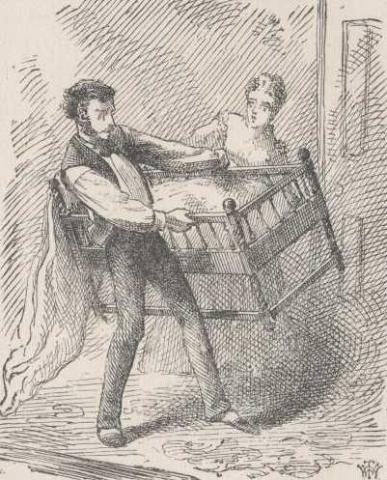


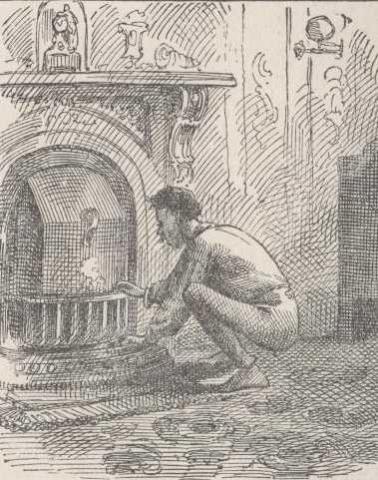
Like the situations in Twain's other McWilliamses stories, this one establishes a situation that lends itself to repetitions of behavior that are but variations upon themselves, as the couple take extraordinary and absurd measures to protect the health of their children, the ailing Penelope and their baby, moving the crib in and out of the nursery, nearer and farther from the fire in the couple's bedroom fireplace, adjusting the temperature of their room up and down, dismissing and recalling the nurse, and Caroline's awakening Mortimer from his sleep to carry out a series of absurd actions related to her nearly hysterical concern for their children. Through such repetition, both in this story and in the other two of the series, Twain extends the narratives' opportunities for humorous treatment, the humor resulting as much from situations involving such repetition of actions as from the opposing traits of the couple's characters.


During the course of the story, Twain employs a number of techniques, many of which are also used in his other McWilliamses stories:


Irony and exaggeration: In response to Caroline's refusal to concede the validity of his logic that the pine wood stick that Penelope chews is not of any nutritional or medicinal value, Mortimer says, “Say no more, my dear. I now see the force of your reasoning, and I will go and order two or three cords of the best pine wood to-day.”


Simile: “sleeps like a graven image”


Comparison: “you know no more what you are talking about than the child unborn”


Misdirected concern: Caroline is more concerned about the condition of her furniture and the family's cat than she is that of Mortimer.


Irony: Caroline insists that Mortimer sleep, letting her take care of Penelope and the baby, but she keeps waking him to ask that he undertake another useless task


Redundancy: “I did not finish, because I was interrupted.”


Irony, through impossibility: “he must come, dead or alive.”


Irony through motive: “Very few married men have such an experience as McWilliams's and so the author of this book thought that maybe the novelty of it would give it a passing interest to the reader.”


Situational irony: Penelope's condition is not the result of the membranous croup, after all, the doctor determines, but of her having swallowed “a bit of pine,” from which she “got some little slivers in her throat.”


“Mrs. McWilliams and the Lightning”


My personal favorite of the three, “Mrs. McWilliams and the Lightning,” is based on the wife's fear of lightning. Now known as Evangeline, Mrs. McWilliams awakens her sleeping husband with her panicked shouts of “Mortimer! Mortimer!”


The story makes good on Mortimer's claims, at the outset of the narrative, that his wife's “fear of lightning . . . . is something pitiful to see.”


As in the previous McWilliamses story, the wife is emotional, superstitious, argumentative, and gullible, while Mortimer is rational, put-upon, long-suffering, and henpecked. Only the name of the wife differs in regard to the characters; children are mentioned, but they play no substantial part in the plot.


Evangeline, who does her own share of arguing, all Mortimer seems to do, in response to her claims and her concerns is to “argue it, and argue it, and argue it!” Of course, in doing so, from a logical point of view, he is correct. He is right, for example, that a man cannot “be ashamed when he is asleep.” He is right that swearing does not cause lightning, and he is right that saying “confound it” is not swearing. He is right that ;light does not attract lightning. He is right that not having said his prayers does not cause lightning—or, for that matter, the past occurrences of earthquake and yellow fever that Evangeline blames on his swearing. He is right that his standing in front of their fireplace cannot result in lightning. Nevertheless, his reasoning does not win the argument; Evangeline remains persuaded, because of her readings of esoteric texts, that her husband is wrong and that his behavior is, in effect, a lightning rod that could bring destruction down on them both.


Evangeline's retorts to Mortimer's rational appeals show the tactics she uses to manage and subdue her husband; she charges him, directly or indirectly, with shame, carelessness, recklessness, profligacy, argumentativeness, irreverence, irrationality, and willful ignorance. Although it may be that he does not accept the validity or justice of such criticisms, Mortimer seems more concerned with allaying Evangeline's fears than with winning his argument, which suggests that he loves her, despite her eccentricity, just as her expressions of concern for him and their children implies her devotion to him and their family.


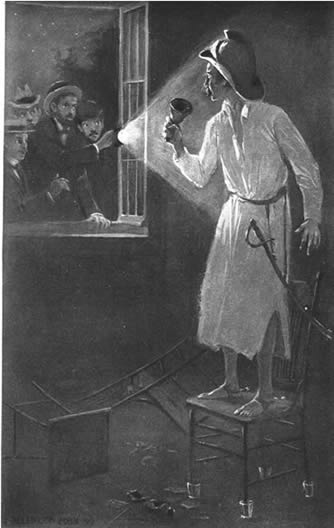
Another source of the humor in this story is Evangeline's attempt to translate an esoteric German text that is clearly incomprehensible to her (and to Mortimer). Believing the book to offer guidance concerning how to deflect lightning, she orders Mortimer to outfit himself in metal objects: his fireman's helmet, his military saber, and his spurs, and to ring their dinner bell, all while standing on a chair. The ringing of the bell causes his neighbors to appear, demanding to know “what in the nation is the matter here?”


The story's punchline comes as the neighbors notify Mortimer that the lightning and thunder he and Evangeline have perceived is, in fact, merely the sound and the flashes of the cannon fire celebrating Garfield's nomination for president. Outside, he is told, “It is a beautiful starlight night.” Due to his wife's superstition and fear, Mortimer has become the laughingstock of the neighborhood and appears himself to be superstitious and fearful.


This story also uses repetition ans a means to both extend the humor and to create a variety of humorous effects. However, this time Twain's use of repetition seems more sophisticated, allowing a greater diversity of sources of information that he can use to produce humorous observations and descriptions, such as science, superstition, rationality, emotionalism, religious beliefs, skepticism, pseudoscience, marital relationships, “book-learning,” private vs. public conduct, personal beliefs, and social and political influences.


In the course of the story, Twain uses these specific techniques to effect humor:


Ironic juxtaposition: “a woman . . . could face the very devil himself—or a mouse”


Concealed humor: Twain tucks humorous observations away among seemingly serious statements, the more to surprise his readers.


Mutual foils as the major source of conflict: a rational husband and an hysterical wife


Superstitious beliefs based on books: “all the books say that . . . .”


Mistaking correlation for causation: cursing causes the flash of lightning that immediately follows Mortimer's “swearing”


Verbal irony: “absolutely at the mercy of Providence”


Simile: “as dark as the inside of an infidel”


Repetition: lightning flashes and thunderbolts allow the extension of the humorous situation through variations of wit and humor; additionally, the husband's alleged profanity has caused not only the current thunderstorm but previous occurrences of earthquakes and yellow fever


Situational irony: a superstitious and irrational wife charges her husband with irrationality, and his actions (lying in bed, standing before an “open fireplace,” “swearing,” standing near a window, approaching a door, standing close to a wall, lighting a match, donning his pantaloons, failing to say his prayers, singing, admitting a draft of air into the bedroom, turning on water, failing to order a feather bed) attract lightning 


Categorical absurdity: the wife regards the use of the word “blessed” as an instance of profanity


Personification: lightning is a “marksman”with bad aim, yet


Dubious cause-and-effect relationships: the wife's shutting herself inside the boot-closet with a book causes her husband to enjoy “a moment's peace”


Ridiculous, unnecessary action causes destruction: chasing a cat destroys $400 worth of furniture


Complex process with ludicrous goal results in absurd actions and husband's becoming a laughingstock


Ignorance compounded by arrogance: The McWilliamses' inability to understand a book written in a foreign language results in ad-libbing ridiculous “translations”


Mistaken effects: cannon fire, not storm, causes effects perceived by the McWilliamses as lightning and thunderbolts


Preliminary, apparent punchline trumped by actual, climactic punchline: not only is Mortimer a laughingstock (preliminary, apparent punchline), but he is also mistaken about the apparent cause of the “lightning” (cannon flashes) and thunder (cannon fire) (actual, climactic punchline)


“Mrs. McWilliams and the Burglar Alarm”


In “Mrs. McWilliams and the Burglar Alarm,” Twain uses the same structure of repetition to milk the situation of its humor. Despite the presence of an expensive, sophisticated burglar alarm, burglars repeatedly burglarize their house. Repeated repairs and adjustments to the burglar alarm merely make the situation worse or introduce new problems. First, the alarm fails to prevent burglaries; then, adjusted (a huge gong is added to the contraption), the alarm works too well, awakening the entire household every time the cook starts the day at five o'clock. In fact, it works so well, it literally wakes the dead. Another repair, due to a series of false alarms, results in so many burglaries that the residents no longer respond to the alarm, surrendering the run of the house to the thieves. The burglar alarm company seeks to remedy this problem by replacing the burglar alarm's clock every three months, which is not only expensive (as all the previous repairs have been), but each effort is “always a failure.”


This story features the following uses techniques:


Spurious cause and effect: “we found we had a little cash left over, on account of the plumber not knowing it.”


Irony through contrasting motives: “I was for enlightening the heathen . . . .[the motive sounds noble], for I was always unaccountably down on the heathen somehow” (but it is really base).


Definition: “whenever I want a thing, and Mrs. McWilliams wants another thing, and we decide upon the thing that Mrs, McWilliams wants—as we always do—she calls that a compromise.”


Punchline: The burglars finally steal the burglar alarm itself.


Play on words: “swear at—sear by, I mean.”


Riff on “summer”: “They [alarm firm workers] promised to have the whole thing finished in ten days. They began work, and we left for the summer. They worked a couple of days; then, they left for the summer. After which the burglars moved in, and began their summer vacation.”


Personification: clocks “would take it [the burglar alarm] off again as soon as your back was turned”


Verbal irony: “those things [burglar alarms] are made solely in the interest of the burglars”


What Could Go Wrong?


One theory of humor finds the source of humor in situations in which a character perceives that something is wrong. Obviously, Twain takes this approach in his McWilliamses stories. Being struck by lightning may not be funny, but as Twain shows, being hysterical about the possibility, which is fairly remote, can be hilarious. What's “wrong” isn't the lightning itself (which, in fact, in the story, never actually occurs), but the irrational fear of it and the behavior that such fear produces. “Mrs. McWilliams and the Lightning” is an account of the multiple results of such hysteria. Twain uses the same approach in his other two stories: In “Experience of the McWilliamses with Membranous Croup,” Evangeline is terrified that her daughter and baby may die from the disease, and her fear fuels the story's humorous effects, as she puts Malcolm (and the rest of her household) through its paces in an effort to save her children, who, as the doctor reveals at the end of the tale, never were at risk, since neither Penelope nor her sibling actually had the membranous croup or any other sickness. “Mrs. McWilliams and the Burglar Alarm” uses the same formula, but, this time, it is an object, more than the characters of the story, that goes wrong, the burglar alarm failing to work at all, working too well, or working at inappropriate times. If such an approach works for Twain, it could work for others, provided, of course, they have Twain's considerable, perhaps unparalleled, gifts as a humorist.


Monday, December 21, 2009

Glossary of Terms

Over the years--and, by “years,” we mean centuries and, in fact, millennia-- humorists and comedians have employed a variety of techniques to get their readers or audiences to giggle, snicker, sniggle, chuckle, chortle, titter, and laugh. Some of the more common, defined, once more, courtesy of Webster’s dictionary, are the following.

A

Absurd: Inconsistent with reason or logic or common sense.*

Analogy: Drawing a comparison in order to show a similarity in some respect.

B

Burlesque: A form of COMEDY characterized by ridiculous exaggerations and distortion: the sublime may be made absurd; honest emotions may be turned to SENTIMENTALITY; a serious subject may be treated frivolously or a frivolous subject seriously. The essential quality that makes for burlesque is the discrepancy between subject matter and style. That is, a style ordinarily dignified may be used for nonsensical matter, or a style very nonsensical may be used to ridicule a weighty subject. . . . A distinction between burlesque and PARODY is often made, in which burlesque is a TRAVESTY of a literary form and parody a travesty of a particular work. It has been suggested that parody works by keeping a targeted style constant while lowering the subject, burlesque or travesty by keeping a targeted subject constant while lowering the style (William Harmon and Hugh Holman, A Handbook to Literature, 10th edition, 74-75).

C

Comedy: A dramatic work in which the protagonist’s fortunes change for the better by the end of the story.

Comedy of Humours: The special type of REALISTIC COMEDY that was developed in the closing years of the sixteenth century by Ben Jonson and George Chapman and that derives its comic interest from the exhibition of CHARACTERS whose conduct is controlled by one characteristic or HUMOUR. Some single psychophysiological humour or exaggerated trait of character gave the important figures in the ACTION a bias or disposition and supplied the chief motive for their actions. Thus, in Jonson’s Every Man in His Humour (acted 1598), which made
this type of PLAY popular, all the words and acts of Kitely are controlled by an overpowering suspicion that his wife is unfaithful; George Downright, a country squire, must be “frank” above all things; the country gull in town determines his every decision by his desire to “catch on” to the manners of the city gallant. In his “Introduction” to Every Man in His Humour (1599), Jonson explains his character formula thus:

Some one peculiar quality
Doth so possess a man, that it doth draw
All his effects, his spirits, and his powers,
In their confluctions, all to run one way.

(William Harmon and Hugh Holman, A Handbook to Literature, 10th edition, 110).

Comedy of Manners: A term designating the realistic, often satirical, comedy of the Restoration, as practiced by Congreve and others. . . . The type concerns the manners and conventions of an artificial, highly sophisticated society. The stylized fashions and manners of this group dominate the surface and determine the pace and tone of this sort of comedy. Characters are more likely to be types than individuals. Plot, though often involving a clever handling of situation and intrigue, is less important than atmosphere, dialogue, and satire. The dialogue is witty and finished, sometimes brilliant. The appeal is more intellectual than imaginative. Satire is directed in the main against the follies and deficiencies of typical characters such as fops, would-be wits, jealous husbands, coxcombs, and others who fail somehow to conform to the conventional attitudes and manners of elegant society. A distinguishing characteristic of the comedy of manners is its emphasis on an illicit love duel, involving at least one pair of witty and often amoral lovers (William Harmon and Hugh Holman, A Handbook to Literature, 10th edition, 111).

Comedy of Morals: A term applied to comedy that uses ridicule to correct abuses, hence a form of dramatic satire, aimed at the moral state of a people or a special class of people (William Harmon and Hugh Holman, A Handbook to Literature, 10th edition, 111).

Comedy of Situation: A comedy concentrating chiefly on ingenuity of plot rather than on character interest; COMEDY OF INTRIGUE. Background is less important than ridiculous and incongruous situations, a heaping up of mistakes, plots within plots, disguises, mistaken identities, unexpected meetings, close calls (William Harmon and Hugh Holman, A Handbook to Literature, 10th edition, 111-112).

Court Comedy: Comedy written to be performed at a royal court. . . . Characteristics include: artificial plot; little action; much use of mythology; pageantry; elaborate costuming and scenery; prominence of music, especially songs; lightness of tome; numerous and often balanced characters (arranged in contrasting pairs); style marked by wit, grace, verbal cleverness, quaint imagery; puns; prose dialogue; witty and saucy pages; eccentric characters such as braggarts, witches, and alchemists; much farcical action; and allegorical meanings sometimes in characters and actions (William Harmon and Hugh Holman, A Handbook to Literature, 10th edition, 125).

D

Double-entendre: A word or expression admitting of a double interpretation, one of which is often obscure or indelicate. Mae West was a master of this device. “I used to be Snow White,” she once quipped, “but then I drifted.”

E

Euphemism: An inoffensive expression that is substituted for one that is considered offensive.

Exaggeration: The act of making something more noticeable than usual; making [something] to seem more important than it really is.

Extravaganza: A fantastic, extravagant, or irregular composition (William Harmon and Hugh Holman, A Handbook to Literature, 10th edition, 209).

Eye Dialect: The misspelling of a word to suggest dialect. . . . In the sentence, “Ah cain’t kum raht naow,” “kum” is an eye dialect spelling (William Harmon and Hugh Holman, A Handbook to Literature, 10th edition, 210).

F

Farce: A dramatic piece intended to excite laughter and depending less on plot and character than on improbable situations, the humor arising from gross incongruities, coarse wit, or horseplay. Farce merges into comedy, and the same play (e. g., Shakespeare’s The Taming of the Shrew) may be called by some a farce, by others a comedy (William Harmon and Hugh Holman, A Handbook to Literature, 10th edition, 213).

Fool: A court jester; in King Lear, Shakespeare labels this clown “the all licensed fool,” referring to the tradition that allowed jesters to speak frankly to the king or queen without fear of reprisal; thus the fool was not a “yes man,” and could serve as a trusted advisor (Pullman).

Framework Story: A type of narrative in which the main story is sandwiched between a prologue and an epilogue (Pullman).

H

High Comedy: Pure or serious comedy as contrasted with LOW COMEDY. High comedy appeals to the intellect and arouses thoughtful laughter by exhibiting the inconsistencies and incongruities of human nature and by displaying the follies of social manners. The purpose is not consciously didactic [educational] or ethical, though serious purpose is often implicit in the satire that is frequent in high comedy. Emotion, especially sentimentality, is avoided. If people make themselves ridiculous by their vanity or ineffective by their conduct or blind adherence to tradition, high comedy laughs at them. . . . Its higher enjoyment demands detachment (William Harmon and Hugh Holman, A Handbook to Literature, 10th edition, 256).

I

Intrigue Comedy: A comedy in which the major interest is in complications resulting from scheming by one or more characters (William Harmon and Hugh Holman, A Handbook to Literature, 10th edition, 279).

Irony: Incongruity between what might be expected and what actually occurs (Pullman).

Dramatic Irony: (Theater) irony that occurs when the meaning of the situation is understood by the audience but not by the characters in the play.

Situational Irony: The incongruity that results when a later situation upsets the expectations set up by an earlier situation.

Verbal Irony: The incongruity that results when what is said is the opposite of what is meant.

J

Juxtaposition: The act of positioning close together (or side by side) (Pullman).

L

Low Comedy: Low comedy has been called “elemental comedy,” in that it lacks seriousness of purpose or subtlety of manner and has little intellectual appeal. Some features are: quarreling, fighting, noisy singing, boisterous conduct in general, boasting, burlesque, trickery, buffoonery, clownishness, drunkenness, coarse jesting, wordplay, and scolding (William Harmon and Hugh Holman, A Handbook to Literature, 10th edition, 303).

M

Malapropism: The unintentional misuse of a word by confusion with one that sounds similar.

Metaphor: A figure of speech in which an expression is used to refer to something that it does not literally denote in order to suggest a similarity.

O

Oxymoron: Conjoining contradictory terms (as in `deafening silence').

Onomatopoeia: Using words that imitate the sound they denote.

P

Parody: A composition that imitates somebody's style in a humorous way. See “Travesty.”

Pun: A humorous play on words; "I do it for the pun of it"

Punch Line: The point of a joke or humorous story. (Mark Twain called the punch line the story’s “snapper.”) (Pullman)

R

Realistic Comedy: Any comedy employing the methods of REALISM but particularly that developed by Jonson, Chapman, Middelton, and other Elizabethan and Jacobean dramatists. It is opposed to the ROMANTIC COMEDY of the Elizabethans. It reflects the general reaction in the late 1590s against extravagance as well as an effort to produce an English comedy like the CLASSICAL. This realistic comedy deals with London life, is strongly satirical and sometimes
cynical, is interested in both individuals and types, and rests on observation of life. The appeal is intellectual and the texture coarse (William Harmon and Hugh Holman, A Handbook to Literature, 10th edition, 431).

Romantic Comedy: A comedy in which serious love is the chief concern and source of interest. . . . Characteristics commonly found include: love as chief motive; much out-of-door action; an idealized heroine (who usually masks as a man); love subjected to great difficulties; poetic justice often violated; balancing of characters; easy reconciliations; and happy ending (William Harmon and Hugh Holman, A Handbook to Literature, 10th edition, 455).

Running Gag: A humorous theme or situation that frequently snowballs as it is repeated and varied over time (Pullman).

S

Satire: Witty language used to convey insults or scorn.

Satire: A work or manner that blends a censorious attitude with humor and wit for improving human institutions or humanity. Satirists attempt through laughter not so much to tear down as to inspire a remodeling. If attackers simply abuse, they are writing invective; if they are personal and splenetic, they are writing SARCASM; if they are sad and morose over the state of society, they are writing IRONY or a JEREMIAD. As a rule, modern satire spares the individual and follows [Joseph] Addison’s self-imposed rule: to “pass over a single foe to charge whole armies.” Most often, satire deals less with sinners and criminals than with the general run of fools, knaves, ninnies, oafs, codgers, and frauds. . . .

. . Before the Revolution, American satire dealt chiefly with the political struggle. . . . Shortly after the Revolution, . . . [satire] attacked domestic political difficulties and the crudities of our frontier. . . . In the twentieth century. . . In America. . . [writers] commented satirically on human beings and their institutions. Satire is of two major types: formal (or direct) satire, in which the satiric voice speaks, usually in the first person, either directly to the reader or to a character in the satire, called the ADVERSARIES [a sort of straight man]; and indirect satire, in which the satire is expressed through a narrative and the characters who are the butt are ridiculed by what they themselves say and do. Much of great literary satire is indirect; one of the principal forms of indirect satire is the MENIPPEAN (William Harmon and Hugh Holman, A Handbook to Literature, 10th edition, 464-465).

Formal satire is fundamentally of two types, named for its distinguished classical practitioners: Horatian is gentle, urbane, smiling; it aims to correct by broadly sympathetic laughter; Juvenalian is biting, bitter, angry; it points with contempt and indignation to the corruption of human beings and institutions.

Addison is a Horatian satirist, [Jonathan] Swift a Juvenilian (William Harmon and Hugh Holman, A Handbook to Literature, 10th edition, 464-465).

Sentimental Comedy: . . . sentimental comedy became very weak dramatically, lacking humor, reality, spice, and lightness of touch. The characters were either so good or so bad that they became caricatures, and plots were violently handled so that virtue would triumph. . . . The sentimental comedy sacrificed dramatic reality in its effort to instruct through an appeal to the heart. The domestic trials of middle-class couples are usually portrayed: Their private woes are exhibited with much emotional stress intended to arouse the spectator’s pity and suspense in advance of the approaching melodramatic happy ending (William Harmon and Hugh Holman, A Handbook to Literature, 10th edition, 477-478).

Simile: A figure of speech that expresses a resemblance between things of different kinds (usually formed with `like' or `as').

Situation Comedy: A humorous drama based on situations that might arise in day-to-day life.
Slapstick: Boisterous comedy with chases and collisions and practical jokes.

Straight Man: The partner in a stand-up comedy act or a situation comedy whose innocent or rational statements set up the comedian’s humorous responses or comments; George Burns was a straight man to his wife, comedienne Gracie Allen, just as Dick Smothers was a straight man to his brother, fellow comedian Tommy (Pullman).

Synecdoche: A trope [figure of speech] in which a part signifies the whole or the whole signifies the part. To be clear, a good synecdoche should be based on an important part of the whole and, usually, the part standing fro the whole ought to be directly associated with the subject under discussion (William Harmon and Hugh Holman, A Handbook to Literature, 10th edition, 513).

T

Through Line: The series of aims that, united, propel a character forward in his or her effort to attain a more complex goal.

Tone: The quality of something (an act or a piece of writing) that reveals the attitudes and presuppositions of the author

Travesty: Writing that by its incongruity of treatment ridicules a subject inherently noble or dignified. . . . Travesty may be thought of as the opposite of the MOCK EPIC, because the latter treats a frivolous subject seriously and the travesty usually presents a serious subject frivolously. . . . In general, PARODY ridicules a style by lowering the subject; travesty, BURLESQUE, and CARICATURE ridicule a subject by lowering the style (William Harmon and Hugh Holman, A Handbook to Literature, 10th edition, 529).

U

Understatement: A statement that is restrained in ironic contrast to what might have been said.

* Unless otherwise indicated, definitions are from Webster’s dictionary, a work in the public domain.

Saturday, December 12, 2009

Humorous Techniques: Mark Twain

Copyright 2009 by Gary Pullman

Mark Twain’s humor involves every technique known to humorists: absurdity, analogy, burlesque, exaggeration, eye dialect, farce, high comedy, low comedy, irony, parody, puns and wordplay, satire, slapstick, travesty, understatement, and others. His work cannot be understood without a good knowledge of the vocabulary of humor.

He remains unmatched by other humorists. A study of his work is a must for anyone who aspires to writing humor. Many of Twain’s books are travelogues or contain generous passages that involve long journeys by one or more characters. A Tramp Abroad, Following the Equator, The Innocents Abroad, Roughing It, Life on the Mississippi, The Adventures of Tom Sawyer, and The Adventures of Huckleberry Finn are some of his major literary works that are either based upon or include domestic or foreign travel.

In his actual life as Samuel Langhorne Clemens, Twain traveled frequently, both in the United States and abroad; his characters frequently did the same. The humorists’ journeys allowed him to compare and contrast the habits and customs of the denizens of one region of the country with those of the residents of another region of the country or the habits and customs of foreigners with those of Americans.

His travels were occasions for him to expose the glaring differences between the claims of travel guidebook authors and his own actual experiences as in visiting them as an unbiased and objective observer.

His voyages also permitted Twain to lampoon local traditions, beliefs, institutions, people, languages, art, and religions as he traveled through Europe, the Middle East, and elsewhere. The expeditions themselves unified his sketches and essays, providing a needed backbone for his pieces and allowing his tone to range from whimsical to irate, from appreciative to annoyed, from delighted to outraged.

Sometimes, the travels that Twain’s characters undertook were fanciful, as in “Captain Stormfield’s Visit to Heaven,” “Three Thousand Years Among the Microbes,” and Satan’s visit to paradise in A Pen Warmed Up in Hell. These excursions were journeys of the mind through theological, philosophical, and social landscapes, constituting examples of high comedy with a more intellectual than sentimental or moral perspective and concern.

Another of Twain’s techniques was to evaluate the past through the eyes of the present. By having a character from nineteenth-century America travel into the past, visiting King Arthur’s Court, he could judge the persons, places, and things of the past, including the hypocrisies and abuses that resulted from and were maintained by the class distinctions between the nobility and the peasantry and the sanctimony and fraudulence of a greedy and politically entrenched clergy. At the same time, he could contrast modern Yankee ingenuity with medieval technology and hardheaded rationalism and realism against superstitious beliefs and the Middle Ages’ aristocracy’s and clergy’s fondness for fantasy.

Much of Twain’s humor also resulted in mistaken identities or masquerades. When a prince and a pauper trade places, each learns how the other lives and, at the same time, Twain provides himself with the opportunity of criticizing both the abuses of power and the conditions that sustain poverty and misery among the peasantry (a stand-in, perhaps, for the lower classes of his own day and ours). 

Likewise, when Huckleberry Finn poses as a girl whose true gender is surmised by the old lady whom he tries to deceive, Twain suggests that much of one’s identity, including his or her gender, is affected, consisting of mere convention, tradition, and habit which are learned rather than innate. The true self is the will, Twain suggests, as it is exercised in moral deliberation, for it is at the climax of The Adventures of Huckleberry Finn that the protagonist is faced with the decision to do the right thing, as both church and state dictate, and report Jim’s whereabouts to a mercenary posse or to remain loyal to his friend. This revelation of the true self would not be possible in the novel had Twain’s humor not first established both the goodness of Huck (and Jim) and the wickedness of the society in which he lives and the corruption of the callous institutions that are supported by this society. Next: A Glossary of Terms