Fascinating Lists!

Showing posts with label joke. Show all posts

Wednesday, October 28, 2020

The Taxonomic Method

 Copyright 2020 by Gary L. Pullman


In The Humor Code: A Global Search for What Makes Things Funny, authors Peter McGraw and Joel Warner share a method of generating humor based upon Greg Dean's taxonomy of comedy.


The method consists of a “target assumption,” a “connector,” a “reinterpretation,” and a “punchline.” The connector is a key word that allows a play on words by which the punchline is effected. The authors provide this example:


My wife is an excellent housekeeper.


The target assumption is that the word housekeeper, which is the connector, refers to a woman who keeps house.


To effect humor, however, the meaning of “keeps house” is reinterpreted, and the new meaning is presented in the punchline that follows:


When we got a divorce, the bitch got the house.


This method, involving plays on words, can be used to generate jokes about almost any topic, including a risque one. Here are a few original examples:


My wife doesn't much care for televised beauty pageants.


She claims they turn our TV into a boob tube.


My hot new girlfriend has put the joy back into my life.


She makes me feel ecstatic!


My wife thinks Marilyn is a class act.


I don't know why she's mad at me: I agreed that Marilyn most certainly is a class ass.


The taxonomic method of creating jokes works, but it tends to be a bit sophomoric, for which reason it's probably not effective more than once or twice in a routine, whether one's gig is on the stage or the page.

Friday, October 23, 2020

Mark Twain's Tips and Techniques of Humor

 Copyright 2020 by Gary L. Pullman


The McWilliamses Stories


Over a period of thirty-seven years, Mark Twain published three short stories about a married couple named the McWilliamses. Caroline (later, Evangeline—did her husband remarry?) is emotional, superstitious, argumentative, and gullible; Mortimer is rational, put-upon, long-suffering, and henpecked. Foils to one another, the spouses' characters, as well as the incidents in which they become involved, provide the fodder for Twain's humorous treatment of them.


The first story, “Experience of the McWilliamses with Membranous Croup,” was published in 1879; the others, “Mrs. McWilliams and the Lightning” and “Mrs. McWilliams and the Burglar Alarm,” followed in 1892 and, posthumously, in 1916, respectively.


“Experience of the McWilliamses with Membranous Croup”


In the first of these stories, Mortimer is relating his and Evangeline's experience with membranous croup, “an acute obstructive laryngitis in young children, usually between the ages of three and six.” (The Free Dictionary by Farlex). Characterized by “a high-pitched cough and difficulty in breathing,” the condition can be caused by either bacteria or a virus ((The Free Dictionary).


The story starts with what appears to be a reference to an incident unrelated to the ailment: Mortimer suggests that their daughter ought not to be “chewing” a stick of pine. His comment prompts an argument from Evangeline for no other reason, according to Mortimer, than the fact that she, like married women in general, “cannot receive even the most palpably judicious suggestion without arguing it.” As evidence to support her view that the chewing of wood, in fact, has medicinal value, Evangeline references the statement of unidentified “doctors” who “all say that the turpentine in pine wood is good for [a] weak back and the kidneys.” When Mortimer presses her on this astonishing declaration, he learns that their child is not afflicted with either condition and further, that Evangeline never implied any such thing.
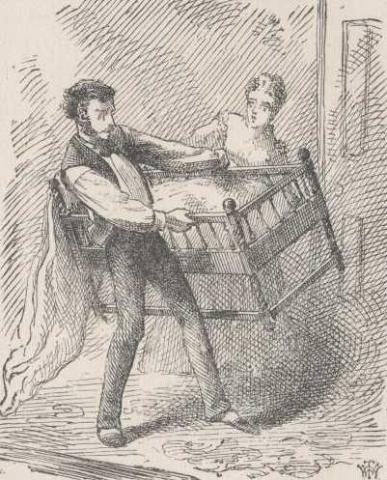


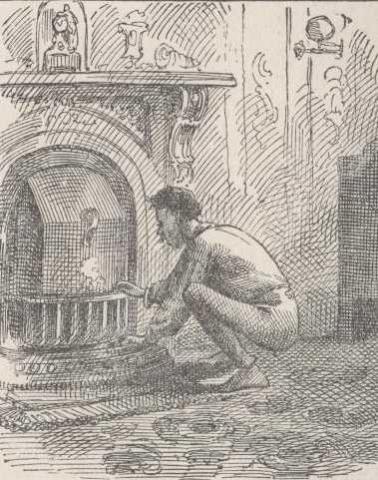
Like the situations in Twain's other McWilliamses stories, this one establishes a situation that lends itself to repetitions of behavior that are but variations upon themselves, as the couple take extraordinary and absurd measures to protect the health of their children, the ailing Penelope and their baby, moving the crib in and out of the nursery, nearer and farther from the fire in the couple's bedroom fireplace, adjusting the temperature of their room up and down, dismissing and recalling the nurse, and Caroline's awakening Mortimer from his sleep to carry out a series of absurd actions related to her nearly hysterical concern for their children. Through such repetition, both in this story and in the other two of the series, Twain extends the narratives' opportunities for humorous treatment, the humor resulting as much from situations involving such repetition of actions as from the opposing traits of the couple's characters.


During the course of the story, Twain employs a number of techniques, many of which are also used in his other McWilliamses stories:


Irony and exaggeration: In response to Caroline's refusal to concede the validity of his logic that the pine wood stick that Penelope chews is not of any nutritional or medicinal value, Mortimer says, “Say no more, my dear. I now see the force of your reasoning, and I will go and order two or three cords of the best pine wood to-day.”


Simile: “sleeps like a graven image”


Comparison: “you know no more what you are talking about than the child unborn”


Misdirected concern: Caroline is more concerned about the condition of her furniture and the family's cat than she is that of Mortimer.


Irony: Caroline insists that Mortimer sleep, letting her take care of Penelope and the baby, but she keeps waking him to ask that he undertake another useless task


Redundancy: “I did not finish, because I was interrupted.”


Irony, through impossibility: “he must come, dead or alive.”


Irony through motive: “Very few married men have such an experience as McWilliams's and so the author of this book thought that maybe the novelty of it would give it a passing interest to the reader.”


Situational irony: Penelope's condition is not the result of the membranous croup, after all, the doctor determines, but of her having swallowed “a bit of pine,” from which she “got some little slivers in her throat.”


“Mrs. McWilliams and the Lightning”


My personal favorite of the three, “Mrs. McWilliams and the Lightning,” is based on the wife's fear of lightning. Now known as Evangeline, Mrs. McWilliams awakens her sleeping husband with her panicked shouts of “Mortimer! Mortimer!”


The story makes good on Mortimer's claims, at the outset of the narrative, that his wife's “fear of lightning . . . . is something pitiful to see.”


As in the previous McWilliamses story, the wife is emotional, superstitious, argumentative, and gullible, while Mortimer is rational, put-upon, long-suffering, and henpecked. Only the name of the wife differs in regard to the characters; children are mentioned, but they play no substantial part in the plot.


Evangeline, who does her own share of arguing, all Mortimer seems to do, in response to her claims and her concerns is to “argue it, and argue it, and argue it!” Of course, in doing so, from a logical point of view, he is correct. He is right, for example, that a man cannot “be ashamed when he is asleep.” He is right that swearing does not cause lightning, and he is right that saying “confound it” is not swearing. He is right that ;light does not attract lightning. He is right that not having said his prayers does not cause lightning—or, for that matter, the past occurrences of earthquake and yellow fever that Evangeline blames on his swearing. He is right that his standing in front of their fireplace cannot result in lightning. Nevertheless, his reasoning does not win the argument; Evangeline remains persuaded, because of her readings of esoteric texts, that her husband is wrong and that his behavior is, in effect, a lightning rod that could bring destruction down on them both.


Evangeline's retorts to Mortimer's rational appeals show the tactics she uses to manage and subdue her husband; she charges him, directly or indirectly, with shame, carelessness, recklessness, profligacy, argumentativeness, irreverence, irrationality, and willful ignorance. Although it may be that he does not accept the validity or justice of such criticisms, Mortimer seems more concerned with allaying Evangeline's fears than with winning his argument, which suggests that he loves her, despite her eccentricity, just as her expressions of concern for him and their children implies her devotion to him and their family.


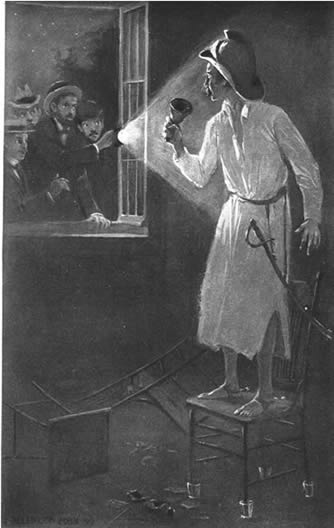
Another source of the humor in this story is Evangeline's attempt to translate an esoteric German text that is clearly incomprehensible to her (and to Mortimer). Believing the book to offer guidance concerning how to deflect lightning, she orders Mortimer to outfit himself in metal objects: his fireman's helmet, his military saber, and his spurs, and to ring their dinner bell, all while standing on a chair. The ringing of the bell causes his neighbors to appear, demanding to know “what in the nation is the matter here?”


The story's punchline comes as the neighbors notify Mortimer that the lightning and thunder he and Evangeline have perceived is, in fact, merely the sound and the flashes of the cannon fire celebrating Garfield's nomination for president. Outside, he is told, “It is a beautiful starlight night.” Due to his wife's superstition and fear, Mortimer has become the laughingstock of the neighborhood and appears himself to be superstitious and fearful.


This story also uses repetition ans a means to both extend the humor and to create a variety of humorous effects. However, this time Twain's use of repetition seems more sophisticated, allowing a greater diversity of sources of information that he can use to produce humorous observations and descriptions, such as science, superstition, rationality, emotionalism, religious beliefs, skepticism, pseudoscience, marital relationships, “book-learning,” private vs. public conduct, personal beliefs, and social and political influences.


In the course of the story, Twain uses these specific techniques to effect humor:


Ironic juxtaposition: “a woman . . . could face the very devil himself—or a mouse”


Concealed humor: Twain tucks humorous observations away among seemingly serious statements, the more to surprise his readers.


Mutual foils as the major source of conflict: a rational husband and an hysterical wife


Superstitious beliefs based on books: “all the books say that . . . .”


Mistaking correlation for causation: cursing causes the flash of lightning that immediately follows Mortimer's “swearing”


Verbal irony: “absolutely at the mercy of Providence”


Simile: “as dark as the inside of an infidel”


Repetition: lightning flashes and thunderbolts allow the extension of the humorous situation through variations of wit and humor; additionally, the husband's alleged profanity has caused not only the current thunderstorm but previous occurrences of earthquakes and yellow fever


Situational irony: a superstitious and irrational wife charges her husband with irrationality, and his actions (lying in bed, standing before an “open fireplace,” “swearing,” standing near a window, approaching a door, standing close to a wall, lighting a match, donning his pantaloons, failing to say his prayers, singing, admitting a draft of air into the bedroom, turning on water, failing to order a feather bed) attract lightning 


Categorical absurdity: the wife regards the use of the word “blessed” as an instance of profanity


Personification: lightning is a “marksman”with bad aim, yet


Dubious cause-and-effect relationships: the wife's shutting herself inside the boot-closet with a book causes her husband to enjoy “a moment's peace”


Ridiculous, unnecessary action causes destruction: chasing a cat destroys $400 worth of furniture


Complex process with ludicrous goal results in absurd actions and husband's becoming a laughingstock


Ignorance compounded by arrogance: The McWilliamses' inability to understand a book written in a foreign language results in ad-libbing ridiculous “translations”


Mistaken effects: cannon fire, not storm, causes effects perceived by the McWilliamses as lightning and thunderbolts


Preliminary, apparent punchline trumped by actual, climactic punchline: not only is Mortimer a laughingstock (preliminary, apparent punchline), but he is also mistaken about the apparent cause of the “lightning” (cannon flashes) and thunder (cannon fire) (actual, climactic punchline)


“Mrs. McWilliams and the Burglar Alarm”


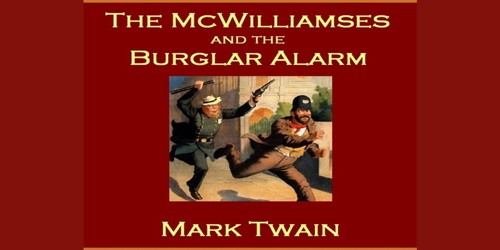
In “Mrs. McWilliams and the Burglar Alarm,” Twain uses the same structure of repetition to milk the situation of its humor. Despite the presence of an expensive, sophisticated burglar alarm, burglars repeatedly burglarize their house. Repeated repairs and adjustments to the burglar alarm merely make the situation worse or introduce new problems. First, the alarm fails to prevent burglaries; then, adjusted (a huge gong is added to the contraption), the alarm works too well, awakening the entire household every time the cook starts the day at five o'clock. In fact, it works so well, it literally wakes the dead. Another repair, due to a series of false alarms, results in so many burglaries that the residents no longer respond to the alarm, surrendering the run of the house to the thieves. The burglar alarm company seeks to remedy this problem by replacing the burglar alarm's clock every three months, which is not only expensive (as all the previous repairs have been), but each effort is “always a failure.”


This story features the following uses techniques:


Spurious cause and effect: “we found we had a little cash left over, on account of the plumber not knowing it.”


Irony through contrasting motives: “I was for enlightening the heathen . . . .[the motive sounds noble], for I was always unaccountably down on the heathen somehow” (but it is really base).


Definition: “whenever I want a thing, and Mrs. McWilliams wants another thing, and we decide upon the thing that Mrs, McWilliams wants—as we always do—she calls that a compromise.”


Punchline: The burglars finally steal the burglar alarm itself.


Play on words: “swear at—sear by, I mean.”


Riff on “summer”: “They [alarm firm workers] promised to have the whole thing finished in ten days. They began work, and we left for the summer. They worked a couple of days; then, they left for the summer. After which the burglars moved in, and began their summer vacation.”


Personification: clocks “would take it [the burglar alarm] off again as soon as your back was turned”


Verbal irony: “those things [burglar alarms] are made solely in the interest of the burglars”


What Could Go Wrong?


One theory of humor finds the source of humor in situations in which a character perceives that something is wrong. Obviously, Twain takes this approach in his McWilliamses stories. Being struck by lightning may not be funny, but as Twain shows, being hysterical about the possibility, which is fairly remote, can be hilarious. What's “wrong” isn't the lightning itself (which, in fact, in the story, never actually occurs), but the irrational fear of it and the behavior that such fear produces. “Mrs. McWilliams and the Lightning” is an account of the multiple results of such hysteria. Twain uses the same approach in his other two stories: In “Experience of the McWilliamses with Membranous Croup,” Evangeline is terrified that her daughter and baby may die from the disease, and her fear fuels the story's humorous effects, as she puts Malcolm (and the rest of her household) through its paces in an effort to save her children, who, as the doctor reveals at the end of the tale, never were at risk, since neither Penelope nor her sibling actually had the membranous croup or any other sickness. “Mrs. McWilliams and the Burglar Alarm” uses the same formula, but, this time, it is an object, more than the characters of the story, that goes wrong, the burglar alarm failing to work at all, working too well, or working at inappropriate times. If such an approach works for Twain, it could work for others, provided, of course, they have Twain's considerable, perhaps unparalleled, gifts as a humorist.


Monday, October 24, 2011

How To Write Hilarious Humor: An Analysis of Professional Comedians' (and Comediennes') Techniques to Tickle the Funny Bone

Copyright 2011 by Gary L. Pullman

Chapter 5: Juvenalian Satire


Another arrow in the humorist’s quiver is Juvenalian satire. Such satire is mild, as opposed to harsh or bitter Horatian satire. Historically, Juvenalian satire’s intent was corrective, aiming at diagnosing an annoying or offensive defect in the personality or an annoying habit that, once brought to the offender’s attention, might be fairly easily remedied, as by repressing the annoying personality trait or suppressing the offensive conduct. On the other hand, Horatian satire’s purpose was to identify obnoxious characteristics or behavior that required more serious or prolonged attention, such as social ostracism.

In “Go Ahead, Open This Bag,” using the Juvenalian approach, Radner exposes her father’s--or a caricature of her father’s--vanity concerning his manliness. Despite--or, perhaps, because of--his age, the narrator’s father, a “seventy-eight-year-old man,” is loathe to ask for assistance from either younger individuals or members of the opposite sex, especially in the performing of so simple a task as opening a bag of peanuts that flight attendants have distributed to the passengers aboard an airplane trip from Miami to Las Vegas.

Until now, Radner has presented her chapters’ set-up situations in short expository paragraphs. In this chapter, she introduces the setup through a series of humorous exchanges of dialogue between father and daughter. The father has flown from his hometown to visit the narrator, and after exchanging “the two-minute father-daughter hug” they’ve “perfected through the years,” the narrator asks her father what he means by his cryptic greeting, “I thought I could do it. Turned out I was mistaken.” Her question sets up the exchange of dialogue in which the reader sees the father’s pride concerning his manliness, which has remained intact despite his advanced age. It is this pride, or vanity, that is subjected to the mild attack of Juvenalian satire throughout the remainder of the chapter.

Unable to open the bag of peanuts the flight attendant has provided, he first blames the bag, rather than himself, for his inability to open the package, suggesting that the bag might have been somehow defective:


“Didn’t the bag have a perforation on one side? Usually, if you look carefully, there’s a perforation."

“I checked. There was no perforation. Possibly, it was a defective bag. I don’t know, I didn’t check other people’s.”
When his daughter asks, “Why didn’t you ask for help?,” the father’s vanity surfaces through his responses:

“I’m a seventy-eight-year-old, two-hundred-pound man. What do you want me to say to the thirty-two-year-old, one-hundred-and-fifteen pound female flight attendant? ‘Will you open this bag of peanuts for me?’ Why don’t I just put on a dress and be done with it?”

“How about the person sitting next to you?”

“I wish you hadn’t asked. She was an eighty-year-old ninety-pounder.”

“And she opened the bag with no problems?”

“She struggled. She finally stabbed it with a fork over Denver.”
The reference to “Denver” is a non-sequitur; the context in which it appears--the stabbing of a bag, as if it were a murder victim who is wounded during a struggle--is both surprising and ridiculous, earning a laugh from the reader.

The next exchange of dialogue further reveals the father’s pride--and his wounded dignity:

“Why didn’t you stab it once you saw there was a way in?”

“Because I shouldn’t have to. I’ve raised a daughter, I’ve been a lawyer. Last year, when the last full-service island closed downtown, I even learned how to pump my own gas. I should be able to open a bag of nuts.”
It is absurd for a man of such accomplishments--a father, a lawyer, and a man who has managed to adapt to changes in technology--to feel that his manhood and his dignity are threatened by his difficulty in performing such a mundane task as opening a bag of peanuts, but, of course, many times, people’s sense of self-worth is threatened by just such ludicrous situations, so, once again, Radner taps a universal experience among her readers, the humorous way in which she depicts a fictionalized version of such an experience lessening the embarrassment and the humiliation that such situations may have caused them by deflecting it onto a surrogate, or stand-in, for them, by showing them how ridiculous both the situation itself and the father’s reactions to it are.

Conclusion

In this chapter, Radner has, once again, selected an everyday situation--an airplane flight--and familiar psychological and social states of affairs--a man’s anxiety about the effects of aging upon his masculinity and his sense of dignity as a man and his refusal to accept the help of others--to set up her comedy. In the process, using mild Juvenalian satire, she criticizes the foolishness of the behavior (the father’s refusal to seek or accept the assistance of others) that results from these anxieties. Her techniques also include humorous dialogue, through which she discloses the story’s conflict while characterizing both her narrator and her narrator’s father; comedic repetition through which a series of jokes are included, all concerning the same topic and situation; and personification that comprises a logical non-sequitur(the bag is characterized as if it is a person).

Thursday, September 22, 2011

How To Write Hilarious Humor: An Analysis of Professional Comedians' (and Comediennes') Techniques to Tickle the Funny Bone


Introduction

Copyright 2011 by Gary L. Pullman


Some of us have it, and some of us don’t. Even when one has it, one can lose it, as the title of Gilda Radner’s hilarious book, I Still Have It . . . I Just Can’t Remember Where I Put It. The “it” in question is, in this book, not Radner’s, one’s sense of humor--and Radner certainly still has hers, that’s for sure.

Moreover, in my book, she’s going to teach you how to use it if you have it. She’s so funny herself that she might teach you how to use it even if you don’t have it yet but are doing everything you can to acquire and develop it

Her secrets will become your knowledge, as you learn how to make people laugh the same way that Radner herself makes her audiences laugh, through such techniques as thematic and topical humor, alliteration, allusions, puns, plays on words, catalogues or lists, intentional digressions, setups and punch lines, metaphors, similes, apt comparisons, personification, exaggeration or hyperbole, repetition, rhetorical questions, run-on text, and many others. End-of-chapter conclusions keep you focused on the meat of the lessons, rather than on the potatoes, and a discussion of her book’s format and her writing style suggests the importance even of these considerations to the generation of laughter.

It will be enormously helpful, to both you and Radner, if you buy her book as an adjunct textbook, because it displays in detail the many techniques for generating humor that are identified and discussed in this handout. Otherwise, you already have it all, because, about all How to Write Hilarious Humor cannot provide you is talent of Radner‘s caliber..

But, then, you already have that.

Next: Chapter 1: Choosing Your Theme

Friday, November 20, 2009

Situation Comedy

Copyright 2009 by Gary L. Pullman

Like playwrights and screenwriters, television situation comedy writers often receive short shrift. They work behind the scenes, not on stage or behind the camera. As a result, many of them remain relatively anonymous. However, one can learn a tremendous amount from them as to how to write humor, even though their media are more visually than textually oriented.

There are too many situation comedies to review in anything less than several volumes, but we can learn much from considering the genre itself, its conventions, techniques, and some specific illustrations of each of these elements.

As the name “situation comedy” (or “sitcom,” as it is often abbreviated) implies, these stories emphasize comical situations, or sets of circumstances, over characters. As a result, their dramatic personae tend to be stock characters of the type which Durant identifies with respect to the ancient Greek’s New Comedy (“the cruel father, the benevolent old man, the prodigal son, the heiress mistaken for a poor girl, the bragging soldier, the clever slave, the flatterer, the parasite, the physician, the priest, the philosopher, the cook, the courtesan, the procuress, and the pimp”); which we have identified with regard to contemporary humor ( the country bumpkin, the con artist, the egghead, the fish out of water (displaced person), the hypocrite, and the blowhard); and which people the pages, as it were, of “An Excerpt of Character Writings of the 17th Century” (see Appendix A). These characters recur on a regular basis, often in a specific setting that reflects a location that is familiar with a wide audience. Homes and workplaces, schools and public places are frequently the settings for such comedies.

The sitcom tells a story, and, although the story is slight and often superficial, it is the occasion for the jokes, humorous anecdotes, and amusing situations that ensue. The story acts much like the string upon which beads or jewels are strung to make a necklace, with the beads or the jewels themselves representing the jokes, humorous anecdotes, and amusing situations. Thus, a sitcom is, at least potentially, doubly delightful: it offers both a comical story and plenty of laughs along the way. Sitcoms have been a major influence on modern humor, both in the United States and around the world, with hundreds and hundreds of them having been produced since their debut, which, arguably, was 1928, the year during which Amos and Andy was launched on American radio. Since their inception, situation comedies have taken on nearly every aspect of contemporary life, from domestic bliss to irascible bosses, from macabre neighbors and busybodies to sentimental slobs, from cute, precocious kids and rebellious teens to battling in-laws and quirky roommates. Therefore, anyone who is interested in writing hilarious humor needs to be aware of the conventions and techniques of the sitcom writer, for, even if one has no intention him- or herself ever of writing a sitcom, the genre has shaped and reshaped comedy and humor, changing audiences’ and readers’ expectations as to what should be regarded as funny. That doesn’t mean that a humorist must write only in the same vein as sitcom writers, but it does mean that the humorist should be aware of the major influence that sitcoms have had on humor in general and comedy in particular.

In The Comic Toolbox: How To Be Funny Even If You’re Not, John Vorhaus, a film and television writer with over 20 years of experience, offers tips concerning how to write speculation scripts, or “specs,” for television situation comedies. Some of his advice applies to humorists of every stripe. For example, Vorhaus advises his readers to “play to your strengths”: “Do you have a knack for gags? Then you want to spec a gag-driven show. Do you have ‘heart’? Then you want to write a sample for a show that has lots of ‘heartfelt’ moments. Can you write kids well? Write a kids’ show spec.” He also reminds his readers to remember that every sitcom has a “rule” that governs how the story will be told. A “rule” for Married. . . With Children, he says, is “that Al Bundy always loses.”

Likewise, “on Murphy Brown there’s often a gag, or even a running gag, about a secretary, but. . . the stories are never built around a secretary.” These rules, he says, affect every element of their respective sitcoms:


A show's rules extend to all aspects of that show. Which character gets the main story? Who gets the secondary stories? Is someone a straight man? Do characters tell jokes and make wisecracks, or do all the laughs come from the characters' comic perspectives? What sort of language do these people use? What topics are taboo? Do they make reference to the outside world, or do they live within a hermetically sealed sitcom bubble? Will given characters act the fool?
Vorhaus also offers excellent instruction as to how the typical sitcom is structured and how he himself applies the genre’s strict guidelines as to how such a comedy should be put together:

Situation comedies are structured either as two-act or three act tales. Mad About You, M*A*S*H and Married. . . with Children are two-act structures; Murphy Brown and The Simpsons play in three acts. Each act ends with an act break, a big dramatic moment which (one hopes) creates a sense of expectation and dread strong enough to hold the viewers' interest across the commercial break and bring them back for more. . . .

. . . In three-act structure, as in two-act structure, it's necessary for the moment before each commercial to have some real drama and urgency, to carry the viewer over the break. I like to think of my three-act act breaks in terms of trouble is coming and trouble is here. At the end of the first act, the characters know that a bad, bad thing is looming on the horizon. At the second act break, the consequences of that bad thing have been brought home. This second break corresponds roughly with the moment of maximum dread in traditional two-act structure. . . .

No matter what happens in your story, remember that situation comedies are essentially circular; things always end up more or less back where they started. If a
character gets fed up with his family and moves out of the house, clearly the act break is the moment when he leaves.

Just as clearly, the story will end with the character having moved back home.

Many sitcoms, Vorhaus points out, have a main story and a secondary, related story, the two of which may (or may not) be connected by their sharing of a common theme:
Many, though not all situation comedies slice themselves up into a-story and b-story. The a-story is the main story, the big problem, the heavy emotional issue with which a given half-hour of television reality chooses to concern itself. Typically, the a-story is given to the star of the show, the main character. Also, the a-story explores the theme of the episode. Whether that theme is, "tell the truth," or "be true to your school," or "don't do stupid things," it's played out in the largest, deepest, and most dramatic sense in the a story.

The b-story is much smaller and lighter than the a story. It usually involves secondary characters. It carries far less emotional weight and gets less screen time than the a-story. In a well crafted sitcom, there's a thematic connection between the a-story and the b-story, in which the b-story comments on and amplifies the meaning of the a-story.

Vorhaus also offers a “shortcut” for writing sitcoms that reveals the basic structure of this genre and provides the humorist with yet another tool for his or her humorists’ toolbox:

. . . I'd like to introduce yet another quick-and-dirty way to get a line on your sitcom story. To use this shortcut, think in the following terms: introduction, complication, consequence, and relevance. The introduction to a sitcom story is the thing that gets the trouble started or puts the tale in motion. An out-of-town guest arrives. An old girlfriend turns up. A first date looms. A driver's license expires. A party is planned.

The complication is the thing that makes the bad situation worse. If the introduction is one character taking cough medicine, the complication is another character bringing the boss home for dinner. If the introduction is one character running for school office, the complication is another character entering the race. If the introduction is a character weaving a lie into an English essay, the complication is that essay winning a major prize. If the introduction is Mr. Wacky going to the doctor, the complication is discovering he only has three weeks to live. The consequence is the result of the conflict created by the introduction and the complication. If two people are running for the same office, then the consequence is the outcome of the election. In the cough medicine story, the consequence is when the cough medicine blows up, so to speak, in the boss's face.

The consequenceof Mr. Wacky facing death is his coming to terms with his mortality, only to discover (since we'd like to run the series for another five years or so) that he's not actually dying after all. The relevance is simply a statement of the story's theme. Stand by your friends. Do the right thing. Don't fear the future. Stop and smell the roses. Accept your own mortality. Shower the people you love with love; that sort of thing.


Earlier, we identified some of the common stock characters of humor and comedy. Using the television sitcoms in which these characters appear as examples, we can get a better idea of how actual sitcoms were developed by referring to the summaries of these shows that are provided by the TV Land website.

The Beverly Hillbillies: Jed and Jethro (front seat); Elly May and Granny (back seat)
For our example of the country bumpkin, we used Jethro Bodine, a character on The Beverly Hillbillies. This show is based upon the premise that Jed Clampett, attempting to kill game he’s hunting near his mountain cabin in Bug Tussle, unearths an underground oil reserve, making him instantly wealthy. He and his family load up their truck and move to Beverly Hills, California, where life, for them (and everyone they encounter there) is decidedly different. TV Land describes the series as “always rich in the absurd”:


. . . The Beverly Hillbillies was chock full of lowbrow but hilarious situations. As sitcom humor would have it, Jed and his brood move next door to the greedy banker, Milburn Drysdale, who in an effort to make his financial institution the home of the Clampett millions, takes the fresh-off-the-farm family under his wing. Most of the early shows revolve around the impossible adjustments the poor mountain folk must make to city life, and Jed Clampett's backwoods brand of wisdom always wins out in the end. Despite their brand-new mansion with its cement pond and indoor plumbing, the Hillbillies stay true to their rustic roots. Many episodes center around
Drysdale's attempts to keep the Clampetts in good spirits in their big city setting (thus keeping their money in his bank). Enrolling Jethro in elementary school, buying Jed a movie studio, letting Granny open a medical practice and finding Elly May a beau are just a few of the silly but entertaining storylines.
Our example of the con artist, Mr. Haney, is taken from the sitcom Green Acres, in which attorney Oliver Wendell Douglas, wanting to get back to the basic way of life that he believes made America great, purchases a run-down farm, complete with ramshackle house and barn, from Mr. Haney, who is forever afterward selling the new farmer an assortment of junk that Douglas does not want or need. The show’s gags result from Douglas’ attempt to farm the unproductive land, producing sparse crops of miniature vegetables that are the laughingstock of his neighbors; the house’s lack of basic utilities, facilities, and utilities, such as a telephone, a closet, and dependable appliances; Douglas’ socialite wife Lisa’s ineptitude as a housewife and her longing to return to Manhattan; the Douglas’ incompetent employee Eb; zany neighbors; Douglas’ naiveté about country life; and his occasional trips to Hooterville.

TV Land describes the show:


Successful lawyer Oliver Wendell Douglas. . . longs to leave behind the complications of modern society and life as a Manhattanite, and despite the protestations of his glamorous, socialite, Hungarian wife Lisa. . . , Oliver buys a farm, sight unseen, from swindler Mr. Haney. The couple says “goodbye[,] city life!” and take up residence in Hooterville, U.S.A. While there is some debate amongst the show's fans as to the actual geographic location of Hooterville, one thing is clear; it exists in a state of mind-bending logic and hallucinatory natural laws, and is inhabited by an eccentric population that includes favorite son Arnold Ziffel, a multi-lingual, television watching pig. The farm Oliver has purchased is a shambles, the farmhouse in a state of advanced disrepair. Along with hired hand Eb, Oliver tries to make a go at being
a gentleman farmer.Meanwhile, Lisa settles in to her new surroundings despite herself, and attempts to bring gracious living and the finer things to the oddball residents of this off-the-map town.
The sitcom M*A*S*H supplied our example of the egghead character in the person, so to speak, of Major Charles Emerson Winchester III. This comedy is set in Korea, during the Korean War. It involves the medical and support personnel of the 4077th Mobile Army Surgical Hospital, or MASH. Commanded by Colonel Sherman T, Potter (who is later replaced by Lt. Col. Henry Blake), Dr. Hawkeye Pierce and Dr. John Francis Xavier McIntyre, who goes by the nickname “Trapper John,” are unconventional doctors who, despite their hatred of war (and the Army), do their best to save the lives of wounded soldiers by practicing “meatball surgery” under less-than-idea conditions. To maintain their sanity, they flaunt Army rules and regulations, play practical jokes on one another, and tease Major Frank Burns and his paramour, Major Margaret (“Hot Lips”) Houlihan, who, despite their affair with one another, insist that everyone else should do everything strictly by the book. Pierce and Honeycutt get away with their unorthodox behavior--keeping a still in their tent, wearing Hawaiian shirts instead of uniforms, and displaying a general lack of disrespect for their superiors--because their surgical skills are not only necessary but extraordinary. Besides Blake, Burns, Houlihan, and Winchester, other characters in the series include Corporal Maxwell Q. Klinger, who sports a dress and wears high heels and carries a purse in the hope of receiving a psychiatric discharged; Colonel Water Eugene (“Radar”) O’Reilly, a clairvoyant clerk who announces that casualties are “incoming,” even before he receives official word; and Father Francis Mulcahy, a Catholic priest.

TV Land describes M*A*S*H from the protagonist’s point of view:

For Captain Benjamin Franklin "Hawkeye" Pierce, love and war, politics and
prose, collide at the 4077th Mobile Army Surgical Hospital. He was named Hawkeye
after a character in The Last of the Mohicans.

Hawkeye is originally assigned to work with Captain "Trapper John" McIntyre, the two become fast friends as they figure out a way to mix hi-jinks and humor with the stark reality of war. He forms a bond with seemingly psychic Corporal Walter "Radar" O. Reilly, Corporal Maxwell Klinger, who would do anything to be sent home, including dress in drag, and mild mannered Father Francis Mulcahy. After Trapper
is discharged Life at camp returns to normal for Hawkeye with the arrival of new best friend, Captain B.J. Hunnicutt. Growing more learned by war, through out his tour Hawkeye transforms from a wise cracking practical joker to a man of conscious; but perhaps his biggest strength is the ability to find humor, sanity and humanity in time of war.
We exemplified the fish out of water, or displaced person, character with Will Smith of The Fresh Prince of Bel-Air and with Jethro Bodine and the Clampetts of The Beverly Hillbillies. In Fresh Prince, Will, living in Philadelphia, starts to have trouble with members of a street gang, so his guardian aunt sends him to live with the Banks, well-to-do relatives who live in in Bel Air, California. In his new surroundings, as he is exposed to situations and characters he’d never dreamed of, Will struggles to develop a sense of identity that can include other people’s values, ways of life, beliefs, and concerns and to adjust to his new environment. He is changed for the better by his encounter with his uncle, a judge, his aunt, and their children, Will’s cousins dimwitted Hilary, pedantic Carlton, and young Ashley, just as they are changed for the better by him. Much of the series’ humor comes from Will’s struggle to fit in, from his encountering new ideas and situations, and from his conflict with his uncle and his cousins

Our examples of the hypocrite and the blowhard, Tartuffe and Sir John Falstaff, were taken from dramatic comedies, Tartuffe and King Henry IV, Parts I and II and the Merry Wives of Windsor, respectively, rather than from television sitcoms.

(Because sitcoms’ theme songs often provide a humorous way to introduce the concepts, or premises, of their respective shows, we have included the lyrics of several of them in Appendix C.)

Next: Standup Comedians

Monday, November 16, 2009

“Luann”: A Situation-Based, Character-Driven Comic Strip

Copyright 2009 by Gary Pullman

“Luann,” by Greg Evans, features the teenage exploits of Luann DeGroot; her parents, Frank and Nancy; her brother Brad; Brad’s girlfriend Toni Daytona; and his buddy T. J.; and Luann’s friends and high school classmates, including her best friend Bernice Halper; her romantic rival Tiffany Farrell; and her nerdy admirer Gunther Berger. Occasionally, other characters appear in the strip, including Aaron Hill, the boy upon whom Luann has an unrequited crush; Toni’s abusive ex-boyfriend Dirk; and Bernice’s handicapped, wheelchair-bound ex-boyfriend Zane.

The comic strip is aimed at teenage and young adult readers, although its situations and humor appeal to a general audience. Much of the conflict is situation-based and, as the Internet website Toonopedia’s article on the comic strip points out, concerns “the ordinary hassles of teenage life,” such as Luann’s or Brad’s interaction with their family and friends, but, some sequences include serious or “touchy” issues such as menstruation, “drug abuse,” “drunk driving,” and “cancer” (“Luann”). With the exception of October 25, the theme for the sequence of the comic strip that appeared from October 25 through October 31, 2009, focuses on Halloween and shows the characters’ personalities as they are revealed by their reactions to problems and conflicts that arise from ordinary, everyday situations.

Halloween is a quintessential children’s holiday, and, since “Luann” appeals primarily to teenagers and young adults, its creator focuses most of an entire week’s worth of his comic strip on this festive occasion. The exception is the Sunday, October 25, 2009, edition. All of Evans’ Sunday strips are stand-alone works. They are not part of the daily sequence. Therefore, they must make sense by themselves. The strip for Sunday, October 25, 2009, shows Luann and her friends standing shoulder to shoulder at the front of their classroom. Behind them, the theme of the day’s lesson is written on the chalkboard: “Day of Service--How will you help others?” As their teacher, Mr. Fogarty, looks on, the students tell their peers what each of them intends to do during the Day of Service. Luann is the next to the last in line; Tiffany stands to her left. Each of the students except Tiffany plans to perform a more-or-less significant act of kindness and assistance. Bernice announces that she intends to “visit” a “disabled neighbor.” Crystal plans to “give manicures at the senior center.” Knute will “mentor at the skateboard park.” Delta hopes to “start a citywide volunteer corps.” Gunther intends to “donate extra time at the library.” Luann is going to “clean up litter.” Since all the other students have a relatively important and meaningful task in mind for the Day of Service, the reader anticipates that Tiffany, the last in line, will also have a noble and helpful task in mind. However, her announcement surprises both Luann and the reader. When Tiffany declares that she will do all that she “can to look incredibly gorgeous,” Luann turns to her, in the next panel, and asks, “How does that help others, Tiffany?” Although her explanation is obviously ludicrous, it reflects her shallow and narcissistic character, and, juxtaposed to her peers’ more important plans to help others, is amusing.

The rest of the week focuses upon Halloween. In the October 26, 2009, strip, Frank and Nancy, seated across from one another in their living room, discuss what to hand out to visiting trick or treaters. Nancy confides to her husband, “I didn’t buy Halloween candy. I hate it that kids gorge on sweets, but I don’t know what to give. Carrots? Toys? Dimes?” Her practical husband suggests “garage stuff.” His response seems to surprise Nancy. “What?” she asks him. “We have junk in the garage we plan to sell,” Frank tells her. “Give it to the kids. Win-win.” Unimpressed, Nancy illustrates the absurdity of Frank’s suggestion. Pretending to give the garage items to visiting trick or treaters, she says, as if she were speaking to them, “A bent golf club for you, an ugly tie for you, a half roll of wallpaper for you, a broken lamp for you.” Her humorous protest prompts Frank to response, “See? It’s even kinda scary.” This strip uses a problem--children’s stuffing themselves with “sweets”--to set up a humorous attempt by the characters to find a solution. Nancy’s suggestions for alternative treats (“carrots. . . toys. . . dimes”) are serious, but Frank’s (“junk in the garage”) is both playfully self-serving and humorous. The strip combines a serious health issue with an everyday situation (cleaning out the family’s garage) and a holiday (Halloween) to appeal to a wide audience, which includes both children, adults, parents, and homeowners.

The October 27, 2009, edition of the comic strip continues the situation that the previous day’s installment established: what to give visiting trick or treaters on Halloween. Again, Frank and Nancy are seated opposite one another in their living room. Nancy opens the conversation between them: “I think I’ll bake sugarless bran muffins for Halloween treats.” Frank offers an interesting alternative. At first, it sounds ridiculous, even a bit cruel: “Here’s a better idea. Take one of our 500-piece jigsaw puzzles and give each kid a handful of pieces.” However, in the next panel, he explains his reasoning, and the idea doesn’t seem as absurd: “The kids will have to get together to assemble the puzzle. They’ll make new friends! It’ll strengthen the very fiber of our neighborhood!” Nancy’s response is based upon a play on the word “fiber” that Frank has used. “My bran muffins are all about fiber,” she observes. “Yeah,” Frank replies, “but it’s the kind that tends to separate people.” His response suggests that the fiber in the muffins will facilitate the children’s need to use the bathroom, since fiber has a laxative effect on people, and their doing so will cause them to “separate” rather than to “assemble.” This strip shows that both Nancy and Frank care about the welfare of children. Nancy has their health in mind, whereas Frank is concerned with their social wellbeing. Their proposed solutions to the problem of what treats to hand out to children on Halloween also show them to be creative. The conflict between them is gentle and rational, rather than harsh and emotional, showing that they are mature and logical adults. Like many of Evans’ other strips, this one, based upon a specific situation, reveals the traits of his characters’ personalities.

The October 28, 2009, edition of the comic strip continues the same situation, as Frank, discovering a kitchen “drawer full of rubber bands from the newspaper” to which they subscribe, suggests to Nancy, as she pours a cup of coffee, “Let’s give these out to the trick or treaters.” She asks a logical question in response, wondering what the recipients “are supposed to do with a rubber band.” In the next panel, Frank explains, “Honey, they’re kids. They’ll think of things.” Nancy agrees, but her rejoinder suggests that the “things” of which the children are apt to think to do with the rubber bands may be undesirable and, potentially, hazardous: “Yeah. Like zing you upside the head as you close the door.” Frank’s suggestion is based upon his understanding that children are imaginative, but Nancy’s comeback addresses another facet of adolescent behavior. Children, she suggests, are also unruly, and their rowdiness could cause unpleasant or dangerous results. It is evident that both characters, as the parents of Luann and Brad, understand children well. The strip also seems to imply that, in caring for children, two heads are better than one, because both Frank and Nancy contribute to an awareness of the nature of children which is truer and more developed than either of their perceptions would be by itself. Children are imaginative, as Frank points out, but they are also immature and disorderly at times, as Nancy indicates.

The October 29, 2009, edition of “Luann” is atypical in that it is not humorous in itself. Rather, it sets up the strip that is to appear the next day and, as the inclusion of a web address in the lower right corner of its single panel indicates, it is more of a public service effort than it is an attempt to tell a joke or to express humor. This time, the action, such as it is, occurs in Luann’s bedroom, as her dog Puddles sleeps on her bed and her best friend Bernice, reading a magazine or a book, lounges on the floor, her back against the side of the mattress, while Luann contemplates a large collection of books in her bookcase. Bernice reads to Luann some facts that have captured her attention: “Wow. In America, kids collect almost 3 billion pieces of candy on Halloween.” She finds this information disturbing because of the hazards to children’s health that it represents: “That’s a lot of hyper, obese, bad-teeth kids.” Luann, contemplating her bookcase, says, “Look at all these old children’s books of mine. Wonder what I could do with them?” A teenager, she has outgrown the “children’s books.” What were once welcome diversions are now undesirable clutter to her. However, possibly because they have sentimental value to her, she doesn’t appear to want to simply discard them, for she wonders what she “could do with them.” The strip for the next day will provide the solution to her problem.

In the October 30, 2009 strip, Frank and Nancy are still trying to resolve their problem as to what to give trick or treaters in lieu of candy. This time, they are seated at the dining room table. Nancy names “apples” and “stickers” and other possibilities. Frank, once again, suggests an absurd alternative: “paper clips.” As her parents struggle with the issue, Nancy listing their ideas on a sheet of paper, Luann approaches them, carrying a tall stack of books. “How ‘bout givin’ my old children’s books?” she suggests. In the next panel, the parents are alone again, Luann having left the stack of books on the table. Her mother and father stare at the books, speechless. In the last panel, Nancy tosses her crumpled list as Frank offers the strip’s punch line: “It’s scary when she’s more clever than we are, isn’t it?” Although this strip, considered in isolation from the previous editions in the sequence, is not all that amusing in itself, its humor becomes funnier because it builds upon the continuing situation that previous days’ editions of the strip have developed, this one becoming, as it were, not only amusing in itself but the punch line for the whole series of related strips to date. Because Frank and Nancy have considered a series of possible alternatives to the giving of candy to visiting children as Halloween treats without success, Luann’s casual resolution of their long-running dilemma is also amusing, since she is a teenager, while they are adults. Usually, the parents solve problems, but, in this strip, the roles of parents and child are reversed, which helps to fuel the amusement.

The October 31, 2009, edition of the comic strip represents the culmination of the Halloween-based series as children visit the DeGroot household to trick or treat. Luann hands out the books. “Just for you,” she says to a girl in a witch’s costume, naming the title of the book she is giving her, “If I Ran the Zoo.” Her announcement of the book’s title brings her father running, as he cries out, in horror at the thought of the loss of the book, “That book is inscribed by Ted Geisel inside!” His announcement shocks Luann, who stares wide-eyed and speechless. “Ted Geisel” is the actual name of the author who has written a popular series of children’s books under the pen name “Dr. Seuss.” The fact that he has “inscribed” the book that Luann is giving away suggests that the volume may be worth a fair amount of money. As such, it is not something that is appropriate to be given away to a child, which explains Frank’s horror and the speed with which he intervenes as well as Luann’s own shock. Luann’s diplomatic way of resolving this crisis is to offer the child two books for the one that she originally gives her, and the girl gladly accepts, so that, at the end, everyone--the girl, Luann, and Frank--is content with the outcome. Luann’s actions show her to be sensitive, kind, and tactful. She may be a teenager, but she is maturing well emotionally and morally, her behavior suggests. She is also witty, because her dialogue, constituting, as it does, a rhymed couplet, in her offering of two books for the one she originally gives the girl, resembles the rhyming couplets in which Dr. Seuss’ books are written.

Just as she earlier solved her parents’ dilemma concerning what to give trick or treaters instead of candy, Luann now resolves the crisis of reclaiming the book she originally gives a child in a diplomatic, and even witty, manner. Although her parents are obviously mature adults--Frank provides for the financial necessities of a family of four, just as Nancy keeps house for them, and both parents show an understanding of and a concern for both their own children and children in general--both Nancy and Frank can also act childishly on occasion, as is indicated by Frank’s panic at the possibility of losing a book signed by a famous author and his grabbing it out of Luann’s hands the moment she retrieves it from the trick or treater and Nancy’s earlier insistence that her bran muffins were superior to Frank’s suggestion for a Halloween treat because her muffins would be “all about fiber.” The comedy of “Luann” springs from Evans’ display of his characters’ personalities through their responses to the problems and conflicts which arise from specific situations related to everyday life. Such humor appeals to children, teenagers, parents, and other adults alike.

Works Cited
Evans, Greg. “Luann.” Comic Strip. The Las Vegas Review-Journal.
25 Oct. 2009-31 Oct. 2009: C8. Print.

Markstein, Don. (2009). Luann. Don Markstein’s Toonopedia. Retrieved November 4, 2009, from http://www.toonopedia.com/luann.htm.


Next: Situation Comedy