Fascinating Lists!

Showing posts with label Mark Twain. Show all posts

Friday, October 23, 2020

Mark Twain's Tips and Techniques of Humor

 Copyright 2020 by Gary L. Pullman


The McWilliamses Stories


Over a period of thirty-seven years, Mark Twain published three short stories about a married couple named the McWilliamses. Caroline (later, Evangeline—did her husband remarry?) is emotional, superstitious, argumentative, and gullible; Mortimer is rational, put-upon, long-suffering, and henpecked. Foils to one another, the spouses' characters, as well as the incidents in which they become involved, provide the fodder for Twain's humorous treatment of them.


The first story, “Experience of the McWilliamses with Membranous Croup,” was published in 1879; the others, “Mrs. McWilliams and the Lightning” and “Mrs. McWilliams and the Burglar Alarm,” followed in 1892 and, posthumously, in 1916, respectively.


“Experience of the McWilliamses with Membranous Croup”


In the first of these stories, Mortimer is relating his and Evangeline's experience with membranous croup, “an acute obstructive laryngitis in young children, usually between the ages of three and six.” (The Free Dictionary by Farlex). Characterized by “a high-pitched cough and difficulty in breathing,” the condition can be caused by either bacteria or a virus ((The Free Dictionary).


The story starts with what appears to be a reference to an incident unrelated to the ailment: Mortimer suggests that their daughter ought not to be “chewing” a stick of pine. His comment prompts an argument from Evangeline for no other reason, according to Mortimer, than the fact that she, like married women in general, “cannot receive even the most palpably judicious suggestion without arguing it.” As evidence to support her view that the chewing of wood, in fact, has medicinal value, Evangeline references the statement of unidentified “doctors” who “all say that the turpentine in pine wood is good for [a] weak back and the kidneys.” When Mortimer presses her on this astonishing declaration, he learns that their child is not afflicted with either condition and further, that Evangeline never implied any such thing.
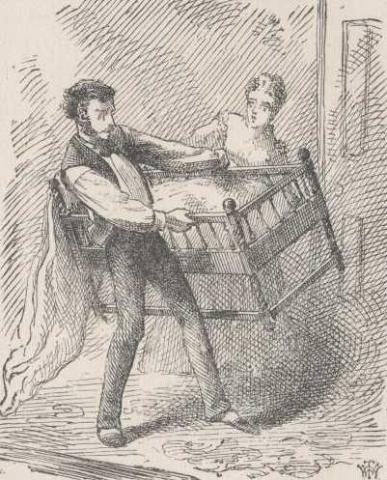


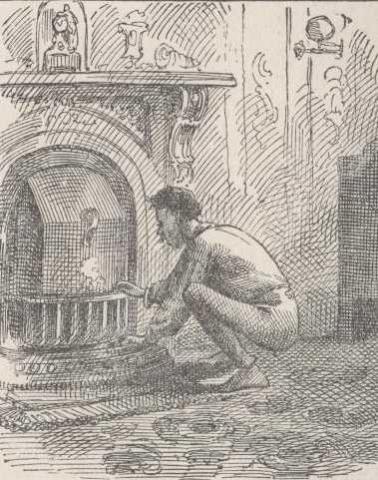
Like the situations in Twain's other McWilliamses stories, this one establishes a situation that lends itself to repetitions of behavior that are but variations upon themselves, as the couple take extraordinary and absurd measures to protect the health of their children, the ailing Penelope and their baby, moving the crib in and out of the nursery, nearer and farther from the fire in the couple's bedroom fireplace, adjusting the temperature of their room up and down, dismissing and recalling the nurse, and Caroline's awakening Mortimer from his sleep to carry out a series of absurd actions related to her nearly hysterical concern for their children. Through such repetition, both in this story and in the other two of the series, Twain extends the narratives' opportunities for humorous treatment, the humor resulting as much from situations involving such repetition of actions as from the opposing traits of the couple's characters.


During the course of the story, Twain employs a number of techniques, many of which are also used in his other McWilliamses stories:


Irony and exaggeration: In response to Caroline's refusal to concede the validity of his logic that the pine wood stick that Penelope chews is not of any nutritional or medicinal value, Mortimer says, “Say no more, my dear. I now see the force of your reasoning, and I will go and order two or three cords of the best pine wood to-day.”


Simile: “sleeps like a graven image”


Comparison: “you know no more what you are talking about than the child unborn”


Misdirected concern: Caroline is more concerned about the condition of her furniture and the family's cat than she is that of Mortimer.


Irony: Caroline insists that Mortimer sleep, letting her take care of Penelope and the baby, but she keeps waking him to ask that he undertake another useless task


Redundancy: “I did not finish, because I was interrupted.”


Irony, through impossibility: “he must come, dead or alive.”


Irony through motive: “Very few married men have such an experience as McWilliams's and so the author of this book thought that maybe the novelty of it would give it a passing interest to the reader.”


Situational irony: Penelope's condition is not the result of the membranous croup, after all, the doctor determines, but of her having swallowed “a bit of pine,” from which she “got some little slivers in her throat.”


“Mrs. McWilliams and the Lightning”


My personal favorite of the three, “Mrs. McWilliams and the Lightning,” is based on the wife's fear of lightning. Now known as Evangeline, Mrs. McWilliams awakens her sleeping husband with her panicked shouts of “Mortimer! Mortimer!”


The story makes good on Mortimer's claims, at the outset of the narrative, that his wife's “fear of lightning . . . . is something pitiful to see.”


As in the previous McWilliamses story, the wife is emotional, superstitious, argumentative, and gullible, while Mortimer is rational, put-upon, long-suffering, and henpecked. Only the name of the wife differs in regard to the characters; children are mentioned, but they play no substantial part in the plot.


Evangeline, who does her own share of arguing, all Mortimer seems to do, in response to her claims and her concerns is to “argue it, and argue it, and argue it!” Of course, in doing so, from a logical point of view, he is correct. He is right, for example, that a man cannot “be ashamed when he is asleep.” He is right that swearing does not cause lightning, and he is right that saying “confound it” is not swearing. He is right that ;light does not attract lightning. He is right that not having said his prayers does not cause lightning—or, for that matter, the past occurrences of earthquake and yellow fever that Evangeline blames on his swearing. He is right that his standing in front of their fireplace cannot result in lightning. Nevertheless, his reasoning does not win the argument; Evangeline remains persuaded, because of her readings of esoteric texts, that her husband is wrong and that his behavior is, in effect, a lightning rod that could bring destruction down on them both.


Evangeline's retorts to Mortimer's rational appeals show the tactics she uses to manage and subdue her husband; she charges him, directly or indirectly, with shame, carelessness, recklessness, profligacy, argumentativeness, irreverence, irrationality, and willful ignorance. Although it may be that he does not accept the validity or justice of such criticisms, Mortimer seems more concerned with allaying Evangeline's fears than with winning his argument, which suggests that he loves her, despite her eccentricity, just as her expressions of concern for him and their children implies her devotion to him and their family.


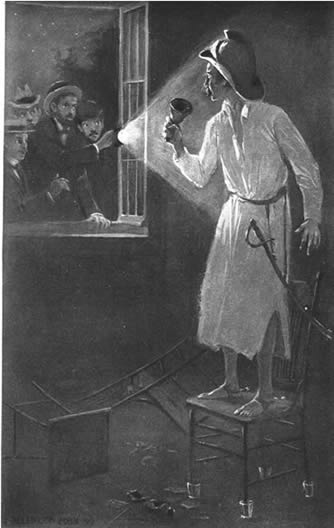
Another source of the humor in this story is Evangeline's attempt to translate an esoteric German text that is clearly incomprehensible to her (and to Mortimer). Believing the book to offer guidance concerning how to deflect lightning, she orders Mortimer to outfit himself in metal objects: his fireman's helmet, his military saber, and his spurs, and to ring their dinner bell, all while standing on a chair. The ringing of the bell causes his neighbors to appear, demanding to know “what in the nation is the matter here?”


The story's punchline comes as the neighbors notify Mortimer that the lightning and thunder he and Evangeline have perceived is, in fact, merely the sound and the flashes of the cannon fire celebrating Garfield's nomination for president. Outside, he is told, “It is a beautiful starlight night.” Due to his wife's superstition and fear, Mortimer has become the laughingstock of the neighborhood and appears himself to be superstitious and fearful.


This story also uses repetition ans a means to both extend the humor and to create a variety of humorous effects. However, this time Twain's use of repetition seems more sophisticated, allowing a greater diversity of sources of information that he can use to produce humorous observations and descriptions, such as science, superstition, rationality, emotionalism, religious beliefs, skepticism, pseudoscience, marital relationships, “book-learning,” private vs. public conduct, personal beliefs, and social and political influences.


In the course of the story, Twain uses these specific techniques to effect humor:


Ironic juxtaposition: “a woman . . . could face the very devil himself—or a mouse”


Concealed humor: Twain tucks humorous observations away among seemingly serious statements, the more to surprise his readers.


Mutual foils as the major source of conflict: a rational husband and an hysterical wife


Superstitious beliefs based on books: “all the books say that . . . .”


Mistaking correlation for causation: cursing causes the flash of lightning that immediately follows Mortimer's “swearing”


Verbal irony: “absolutely at the mercy of Providence”


Simile: “as dark as the inside of an infidel”


Repetition: lightning flashes and thunderbolts allow the extension of the humorous situation through variations of wit and humor; additionally, the husband's alleged profanity has caused not only the current thunderstorm but previous occurrences of earthquakes and yellow fever


Situational irony: a superstitious and irrational wife charges her husband with irrationality, and his actions (lying in bed, standing before an “open fireplace,” “swearing,” standing near a window, approaching a door, standing close to a wall, lighting a match, donning his pantaloons, failing to say his prayers, singing, admitting a draft of air into the bedroom, turning on water, failing to order a feather bed) attract lightning 


Categorical absurdity: the wife regards the use of the word “blessed” as an instance of profanity


Personification: lightning is a “marksman”with bad aim, yet


Dubious cause-and-effect relationships: the wife's shutting herself inside the boot-closet with a book causes her husband to enjoy “a moment's peace”


Ridiculous, unnecessary action causes destruction: chasing a cat destroys $400 worth of furniture


Complex process with ludicrous goal results in absurd actions and husband's becoming a laughingstock


Ignorance compounded by arrogance: The McWilliamses' inability to understand a book written in a foreign language results in ad-libbing ridiculous “translations”


Mistaken effects: cannon fire, not storm, causes effects perceived by the McWilliamses as lightning and thunderbolts


Preliminary, apparent punchline trumped by actual, climactic punchline: not only is Mortimer a laughingstock (preliminary, apparent punchline), but he is also mistaken about the apparent cause of the “lightning” (cannon flashes) and thunder (cannon fire) (actual, climactic punchline)


“Mrs. McWilliams and the Burglar Alarm”


In “Mrs. McWilliams and the Burglar Alarm,” Twain uses the same structure of repetition to milk the situation of its humor. Despite the presence of an expensive, sophisticated burglar alarm, burglars repeatedly burglarize their house. Repeated repairs and adjustments to the burglar alarm merely make the situation worse or introduce new problems. First, the alarm fails to prevent burglaries; then, adjusted (a huge gong is added to the contraption), the alarm works too well, awakening the entire household every time the cook starts the day at five o'clock. In fact, it works so well, it literally wakes the dead. Another repair, due to a series of false alarms, results in so many burglaries that the residents no longer respond to the alarm, surrendering the run of the house to the thieves. The burglar alarm company seeks to remedy this problem by replacing the burglar alarm's clock every three months, which is not only expensive (as all the previous repairs have been), but each effort is “always a failure.”


This story features the following uses techniques:


Spurious cause and effect: “we found we had a little cash left over, on account of the plumber not knowing it.”


Irony through contrasting motives: “I was for enlightening the heathen . . . .[the motive sounds noble], for I was always unaccountably down on the heathen somehow” (but it is really base).


Definition: “whenever I want a thing, and Mrs. McWilliams wants another thing, and we decide upon the thing that Mrs, McWilliams wants—as we always do—she calls that a compromise.”


Punchline: The burglars finally steal the burglar alarm itself.


Play on words: “swear at—sear by, I mean.”


Riff on “summer”: “They [alarm firm workers] promised to have the whole thing finished in ten days. They began work, and we left for the summer. They worked a couple of days; then, they left for the summer. After which the burglars moved in, and began their summer vacation.”


Personification: clocks “would take it [the burglar alarm] off again as soon as your back was turned”


Verbal irony: “those things [burglar alarms] are made solely in the interest of the burglars”


What Could Go Wrong?


One theory of humor finds the source of humor in situations in which a character perceives that something is wrong. Obviously, Twain takes this approach in his McWilliamses stories. Being struck by lightning may not be funny, but as Twain shows, being hysterical about the possibility, which is fairly remote, can be hilarious. What's “wrong” isn't the lightning itself (which, in fact, in the story, never actually occurs), but the irrational fear of it and the behavior that such fear produces. “Mrs. McWilliams and the Lightning” is an account of the multiple results of such hysteria. Twain uses the same approach in his other two stories: In “Experience of the McWilliamses with Membranous Croup,” Evangeline is terrified that her daughter and baby may die from the disease, and her fear fuels the story's humorous effects, as she puts Malcolm (and the rest of her household) through its paces in an effort to save her children, who, as the doctor reveals at the end of the tale, never were at risk, since neither Penelope nor her sibling actually had the membranous croup or any other sickness. “Mrs. McWilliams and the Burglar Alarm” uses the same formula, but, this time, it is an object, more than the characters of the story, that goes wrong, the burglar alarm failing to work at all, working too well, or working at inappropriate times. If such an approach works for Twain, it could work for others, provided, of course, they have Twain's considerable, perhaps unparalleled, gifts as a humorist.


Thursday, July 2, 2020

Establishing and Structuring Humorous Novels

Copyright 2020 by Gary L. Pullman


For me, Mark Twain is the most humorous humorist that ever wrote humor.


I think part of the reason that he's humorous is that he constructs a plot that provides a sense of progress and a series of burlesques unified through character, setting, and situation. Often, the titles of his books themselves identify or suggest the conceit: A Connecticut Yankee in King Arthur's Court, Life on the Mississippi, A Tramp Abroad.


For example, the idea for A Connecticut Yankee in King Arthur's Court (traveling back in time to set up a continuous contrast between the medieval and the modern) establishes the basis for sustained, continuous humor, satire, parody, and burlesque.


In addition (Twain usually progresses from general to specific), the chapters themselves of his novels suggest the same structure and the same elements: “Camelot,” “King Arthur's Court,” “Knights of the Round Table” . . . “The Eclipse,” “Merlin's Tower,” . . . “The Tournament” . . . .

Internally, each chapter is also structured:

Chapter I (Camelot): the countryside is described; a girl appears; the protagonist approaches the town; a detailed description of the town and several of its residents is presented; Chapter II (King Arthur's Court): The protagonist exchanges dialogue with an old man; the protagonist exchanges dialogue with a page; the protagonist and the page arrive at Sir Kay's castle; the narrator presents a philosophical conclusion (i. e., one of the novel's themes).


This threefold structure indicates, with increasing specificity, the sense of progress, which unifies the story while introducing topics for humor. By the time readers finish the story, the foibles of the novel's characters and the folly of their times (and their view of the world) will have been thoroughly examined, criticized, and lampooned.


In the actual paragraphs of the story, Twain uses many devices to spoof the targets of his humor, including mistaking Camelot for an “asylum”; similes (“as lonesome as Sundays,” “made him look like a forked carrot”); incongruous diction (“”her own merits in . . . respect” to being “a spectacle”); derisive adjectives (“windowless,” “wilderness of thatched cabins,” “crooked alleys,” “unpaved,” “troops of dogs and nude children,” “reeking wallow”); contrast (“a noble cavalcade . . . glorious” vs. “the muck and swine and naked brats”); evaluation (the old man's use of Middle English confirms his status, in the protagonist's eyes, as an inmate of the 'asylum”); personification (“comfort his very liver,” “let that shudder its way home”); metaphor (“he was pretty enough to frame”); incongruous description (“shrimp-colored tights”); and a play on words (“”he informed me he was a page,” but, the narrator says, “you ain't more than a paragraph”).


Twain's technique could be used to set up a variety of other opportunities for humor through such contrasts and conflicts between opposing types of characters:
  • A genius among fools
  • Hercules among the Amazons
  • The experiences that occasion various proverbs
  • A sane man on a ship of fools


Tuesday, April 2, 2019

Writing Prompts for Generating Humor

Copyright 2019 by Gary L. Pullman

Often, performing an exercise can be a way of generating humorous material. Envisioning humorous situations or occasions for humorous writing tends to get the creative juices flowing. To this end, I offer these writing prompts for humor.


Imagine an audience or an occasion. Perhaps you are giving a speech to a particular organization or to commemorate a certain historical event. Now, imagine that you are a well-known humorist—not a comedian (who performs, often in skits or in a stand-up routine delivering one-liners), but a humorist (who writes stories). With your audience or occasion in mind, write your humorous speech.


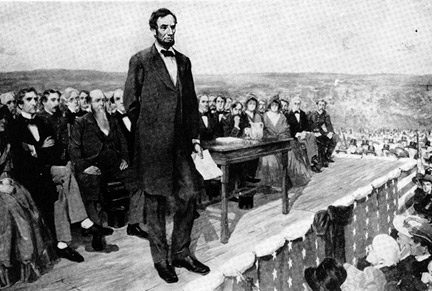
Rewrite a serious speech about a serious topic; make your rewrite humorous. Imagine “The Gettysburg Address” written not by Abraham Lincoln (who had a keen sense of humor himself), but by Mark Twain or Erma Bombeck.


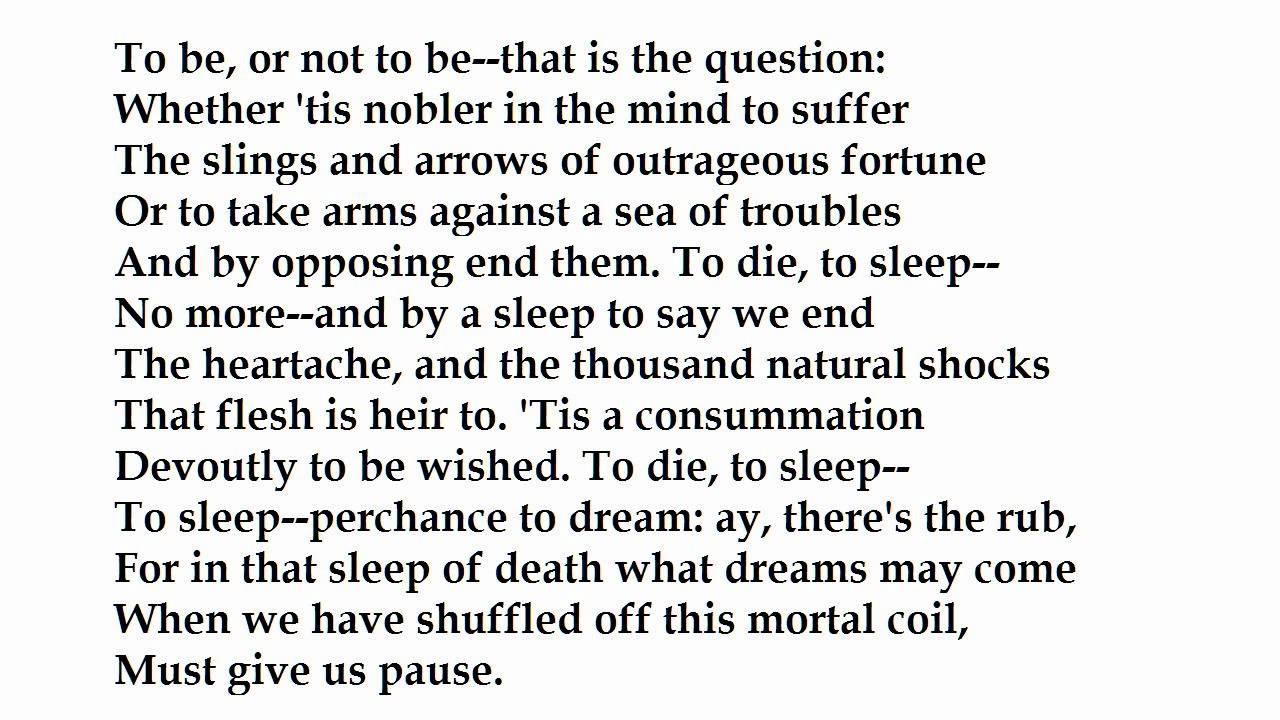
Parody a great poem or one of William Shakespeare's soliloquies. Twain does just this, in The Adventures of Huckleberry Finn, in which The Duke and The Dauphin butcher Hamlet's soliloquy to humorous effect.


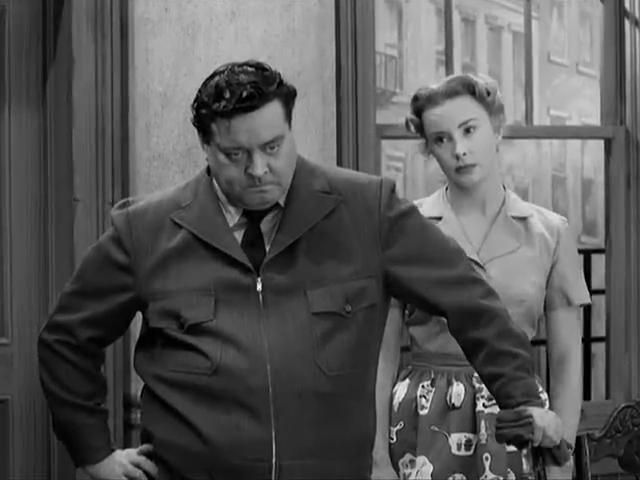
Explain why a supporting character should be the star of a short story, novel, or screenplay. Imagine I Love Lucy with Ethel Mertz, rather than Lucy Ricardo, as the main character or The Beverly Hillbillies with Milburn Drysdale and his wife as the major characters.

Create an imaginary argument between two characters with opposing views on the same topic.


Offer absurd applications of cutting-edge technology. For example, list reasons as to why men or women (or both) should be replaced by robots.


We claim to argue facts, using reason, but, often, desire comes first , arguments in support of our desires second, if at all. Write an argument based on a desire for something insignificant or “forbidden,” using irrelevant and ludicrous “reasons” to support your claims.


 Explain why an honored person, real or imaginary, should be reviled or why a reviled person, real or imagined, should be praised. If the person is real, use two real persons; if imaginary, use two imaginary persons. If the persons are real, write about men and women from the fairly distant past to avoid lawsuits!) Twain was forever trying to secure donations to build a statue to Adam, humanity's common ancestor.


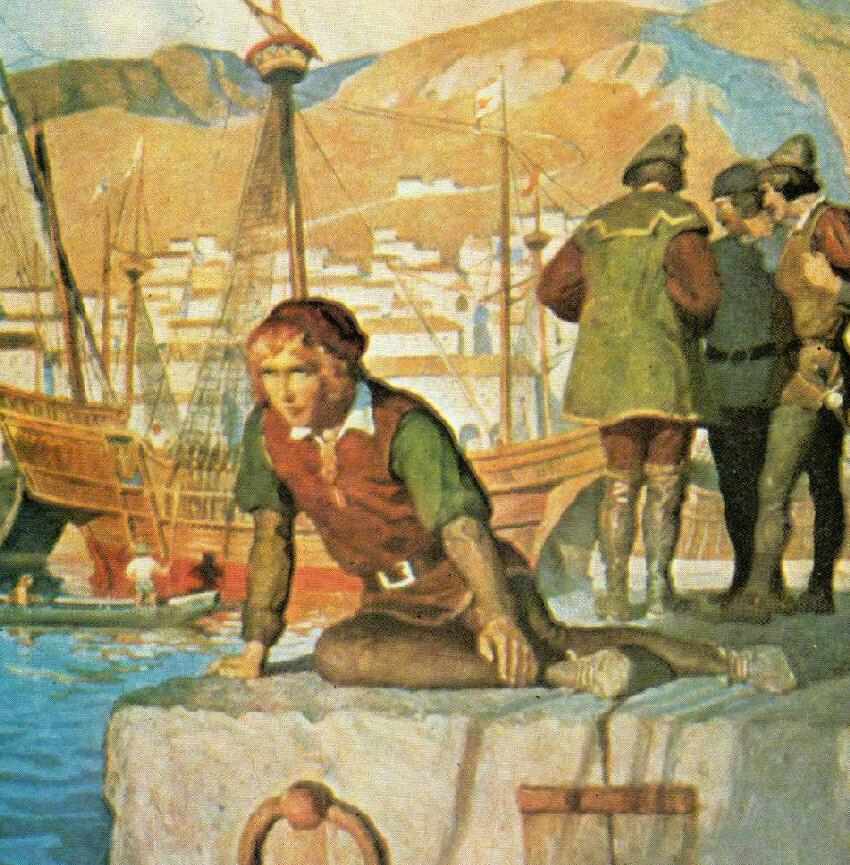
Add a humorous character to a “serious” novel or short story in the public domain. Twain was once interested in creating a fictitious cabin boy to accompany Christopher Columbus on Columbus' explorations.

Tell a story from a different, humorous perspective.


Update a classic, such as The Rape of the Lock, for example.

Imagine a comedian substituting for an actor in an established role: W. C. Fields as Sheriff Andy Taylor, for instance.

Role reversal is often a good source of humor. What if Lucy Ricardo were a band leader and husband Ricky was a stay-at-home husband who aspired to fame and fortune?

Create seemingly absurd, but pointed (and pithy) maxims. Twain does this in Pudd'n'head Wilson. Here's one: “Man is the Only Animal that Blushes. Or needs to.”


Be a team of one! Examine a topic from a variety of perspectives, writing as if you have multiple personalities, each one of which was humorous in his or her own way.


Sunday, December 30, 2018

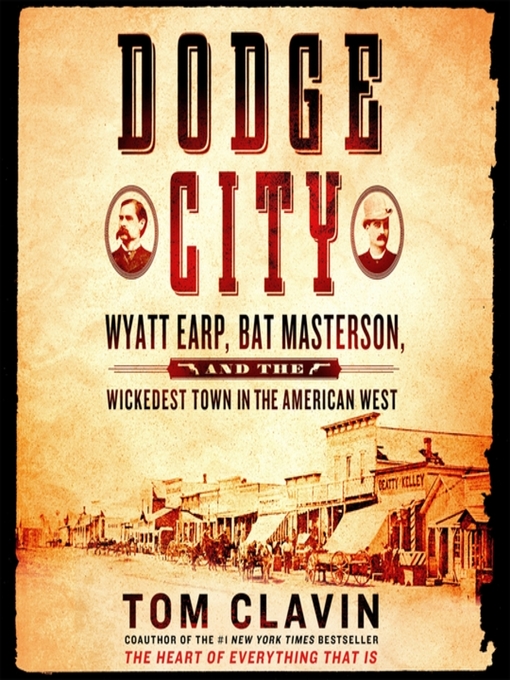
Humor in Tom Clavin's "Dodge City: Wyatt earp, Bat Masterson, and the Wickedest Town in the American West"

Copyright 2018 by Gary L. Pullman


In Dodge City: Wyatt Earp, Bat Masterson, and the Wickedest Town in the American West, Tom Clavin provides an informative, intriguing, and amusing account of law as it was practiced by two of its most famous representatives during their jurisdiction's most lawless times.

The humor, although unexpected, fits the occasions of its use and is effective in fetching a smile, a chuckle, and an occasional belly laugh.

Clavin's humor is typically drawn from the characters and situations he describes. Occasionally, a witticism is subject to a couple of interpretations. For example, in writing of the outlaw Sam Bass's family, Clavin observes, “When he was a young child, both his parents died, perhaps from exhaustion after having ten children” (167). Whether it was so much sex or the child rearing that followed the brood's births depends on one's interpretation.


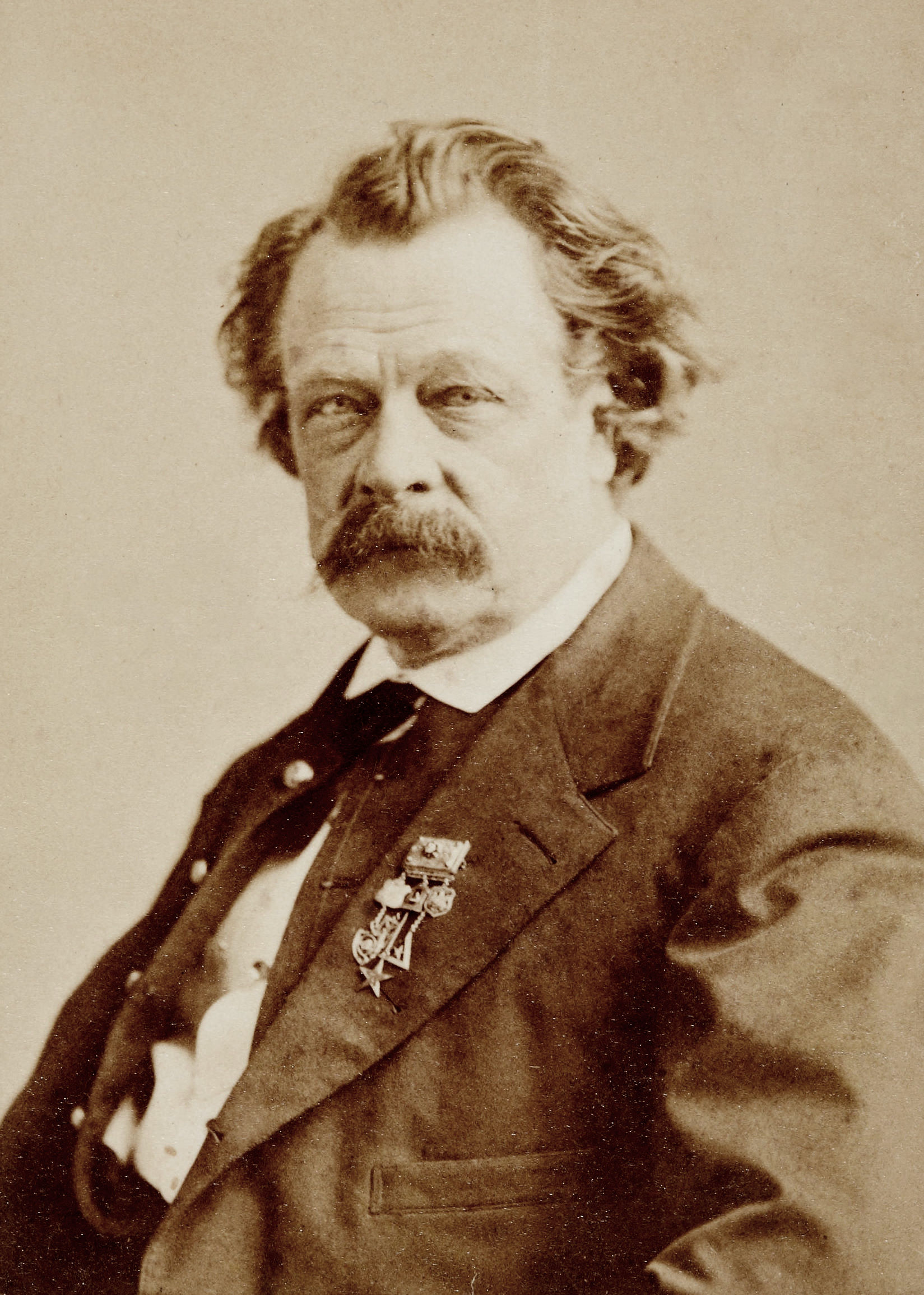
In writing, earlier, of the dime novelist Edward Zane Carroll Judson, who wrote authored 300 or more of these books under his pen name, Ned Buntline, Clavin is at the top of his form, offering such wry remarks as these (bold added):

He always referred to himself as “Colonel” because he was photographed in Mathew Brady's studio wearing such a uniform, which was as close to being an officer as he got (137).

He was paid handsomely for giving lectures on temperance, often delivering them while drunk (138).

He had five children that he knew about (138).

He [Buffalo Bill Cody] met the author in Chicago and starred in a play Buntline had written in only four hours (some critics wondered what took so long) . . . (138).

Clavin's humor often results from his penchant for adding a descriptive phrase that isn't strictly necessary, usually to the ends of his sentences, as if they constitute an afterthought (see the bold phrases in the examples above). In effect, the first parts of the sentences act as the set-up, the second parts as the punchlines, or “snappers,” as Mark Twain would have called them.

A few other examples show that the device works well, despite repetition, since the variety comes by way of the changing tipocs of Clavin's wit (bold added):

Both [Colonel W. H. McCall and “a fellow named Wilson”] were drunk, and they were taking turns trying to shoot a dog, seemingly not concerned that they might also hit the yelping woman who owned the dog (149).

Clavin's account of the life and times of Wyatt and Bat exhibit other techniques of humor as well.


In one instance, the humor depends upon the reader's remembering some intelligence about a certain Dirty Dave Rudabaugh that Clavin delivers, as the set-up to his joke, several pages before the author follows up with his punchline (bold added):

He earned the nickname naturally, by bathing infrequently and wearing clothes that even by frontier standards were quite filthy (171).

. . . Billy the Kid, Rudabaugh, and three others who had joined the gang got away [from the gunfight that ensued a posse's arrival]. They holed up in a cabin near Stinking Springs, which had earned its name naturally, not thanks to Dirty Dave (179).

The gap between Clavin's set-up and punchline suggests that humor can be delayed, if the reader or listener has a good memory for detail and is attentive.


Occasionally, Clavin allows the implications of his subjects' statements to effect his humor. For example, in 1876, as deputy marshal of Dodge City, Wyatt instituted three rules for his officers to follow, one of which, despite its soundness, is made absurd by the self-serving basis (bold added):

. . . Don't shoot to kill, because wounding a man usually disabled him enough and he would be worth more money that way (134).


At least one of Clavin's humorous quips owes its effect to a play on words (bold added):

[When president Hayes visited Dodge Cityin its heyday, the stench of cowdung drove him back into his rfailroad car], leaving Gnereal [William Tecumseh] Sherman and the [Kansas] governor to soldier on as the speech continued (206).


Repeating selected quotations which are amusing in themselves adds to Clavin's humorous presentation of facts (bold added):

The only loaded gun was brandished by the [Dodge City Cowboy Band] director, a man known as Professor Eastman, who used it as a baton. When asked why a gun, eastman replied, “To kill the first man who strikes a false note” (207).

Saturday, December 12, 2009

Humorous Techniques: Mark Twain

Copyright 2009 by Gary Pullman

Mark Twain’s humor involves every technique known to humorists: absurdity, analogy, burlesque, exaggeration, eye dialect, farce, high comedy, low comedy, irony, parody, puns and wordplay, satire, slapstick, travesty, understatement, and others. His work cannot be understood without a good knowledge of the vocabulary of humor.

He remains unmatched by other humorists. A study of his work is a must for anyone who aspires to writing humor. Many of Twain’s books are travelogues or contain generous passages that involve long journeys by one or more characters. A Tramp Abroad, Following the Equator, The Innocents Abroad, Roughing It, Life on the Mississippi, The Adventures of Tom Sawyer, and The Adventures of Huckleberry Finn are some of his major literary works that are either based upon or include domestic or foreign travel.

In his actual life as Samuel Langhorne Clemens, Twain traveled frequently, both in the United States and abroad; his characters frequently did the same. The humorists’ journeys allowed him to compare and contrast the habits and customs of the denizens of one region of the country with those of the residents of another region of the country or the habits and customs of foreigners with those of Americans.

His travels were occasions for him to expose the glaring differences between the claims of travel guidebook authors and his own actual experiences as in visiting them as an unbiased and objective observer.

His voyages also permitted Twain to lampoon local traditions, beliefs, institutions, people, languages, art, and religions as he traveled through Europe, the Middle East, and elsewhere. The expeditions themselves unified his sketches and essays, providing a needed backbone for his pieces and allowing his tone to range from whimsical to irate, from appreciative to annoyed, from delighted to outraged.

Sometimes, the travels that Twain’s characters undertook were fanciful, as in “Captain Stormfield’s Visit to Heaven,” “Three Thousand Years Among the Microbes,” and Satan’s visit to paradise in A Pen Warmed Up in Hell. These excursions were journeys of the mind through theological, philosophical, and social landscapes, constituting examples of high comedy with a more intellectual than sentimental or moral perspective and concern.

Another of Twain’s techniques was to evaluate the past through the eyes of the present. By having a character from nineteenth-century America travel into the past, visiting King Arthur’s Court, he could judge the persons, places, and things of the past, including the hypocrisies and abuses that resulted from and were maintained by the class distinctions between the nobility and the peasantry and the sanctimony and fraudulence of a greedy and politically entrenched clergy. At the same time, he could contrast modern Yankee ingenuity with medieval technology and hardheaded rationalism and realism against superstitious beliefs and the Middle Ages’ aristocracy’s and clergy’s fondness for fantasy.

Much of Twain’s humor also resulted in mistaken identities or masquerades. When a prince and a pauper trade places, each learns how the other lives and, at the same time, Twain provides himself with the opportunity of criticizing both the abuses of power and the conditions that sustain poverty and misery among the peasantry (a stand-in, perhaps, for the lower classes of his own day and ours). 

Likewise, when Huckleberry Finn poses as a girl whose true gender is surmised by the old lady whom he tries to deceive, Twain suggests that much of one’s identity, including his or her gender, is affected, consisting of mere convention, tradition, and habit which are learned rather than innate. The true self is the will, Twain suggests, as it is exercised in moral deliberation, for it is at the climax of The Adventures of Huckleberry Finn that the protagonist is faced with the decision to do the right thing, as both church and state dictate, and report Jim’s whereabouts to a mercenary posse or to remain loyal to his friend. This revelation of the true self would not be possible in the novel had Twain’s humor not first established both the goodness of Huck (and Jim) and the wickedness of the society in which he lives and the corruption of the callous institutions that are supported by this society. Next: A Glossary of Terms

Friday, November 13, 2009

Literary Humorists

Copyright 2009 by Gary L. Pullman

In learning how to write hilarious humor, there is no substitute for knowing the work of famous literary humorists. They are textbooks in themselves, for they have mastered the techniques of humor over careers spanning lifetimes and, indeed, generations. Any list of such humorists must include the following men and women: Mark Twain (Samuel Langhorne Clemens), Voltaire, Miguel de Cervantes, Erma Bombeck, Dave Barry, Dorothy Parker, Art Buchwald, Shirley Jackson, Jean Kerr, William Shakespeare, and Neil Simon.

In addition, many situation comedy writers deserve serious study as literary humorists, even if they write scripts for television shows or movies rather than short stories and novels. It is helpful to consider the influences of such men and women, too--the predecessors and contemporaries from whom they themselves learned how to be funny--and the sources of their humor, when these are discoverable. Of course, in the process, it’s enormously helpful to examine their work and the techniques they use to evoke laughter from their audiences.

Samuel Langhorne Clemens (“Mark Twain”)

In learning to write hilarious humor, there is no substitute for studying the work of great humorists. Chief among them, by most people’s measure, is Samuel Langhorne Clemens, who is more familiar to many by his famous pen name, Mark Twain. The author of such timeless classics of humor as The Adventures of Tom Sawyer, The Adventures of Huckleberry Finn, The Prince and the Pauper, A Connecticut Yankee in King Arthur’s Court, Roughing It, Life on the Mississippi, A Tramp Abroad, Following the Equator, The Innocents Abroad, and a host of other comic masterpieces, Twain, more than any other writer, living or dead, established the genre.

From Twain, the student of horror learns that humor can have a purpose beyond mere entertainment. It can evoke laughter, but it can also lampoon social ills and satirize both the institutions of evil and the institutionalization of evil. Humor can poke fun at traditions, mores, hypocrisy, villainy, culture, and even civilization itself, as Twain’s humor does; at the same time, it can, and, indeed, must, make its readers laugh. Great humor is a double-edge sword, one edge of which provokes laughter while the other cuts through pretense, arrogance, and plain hogwash. Twain’s humor, like that of George Bernard Shaw’s, shows how it is done.

From Twain and other humorists, we also learn another requirement of written humor--that is, humor as it occurs in short stories, novels, plays, and movies, rather than in stand-up comedians’ one-liners and skits. Such humor must be comprised of more than simply a series of unconnected jokes. Written humor of the type with which we are concerned has to be about something; it must have a center and a purpose beyond itself. The jokes and anecdotes and other humorous sequences must be connected by a point of view and a theme.

The point of view, which will be closely allied with the tone of the humor, may be one of gentle censure, harsh satire, tolerant lampoon, insolent farce, or ribald burlesque. The theme, or the point, might be to acknowledge human folly, to identify social injustices, to highlight absurdities in human behavior, to condemn human cruelty, to right social wrongs, or any of a host of other purposes.

There must also be a means by which to unite the humor, the point of view, and the tone--a way, as it were, to give a backbone to the various parts of the organism. Often, this backbone is an analogy of some kind.

Erma Bombeck

In All I Know About Animal Behavior I learned in Loehman’s Dressing Room, Erma Bombeck, inspired, apparently, by Jane Goodall’s study of primate behavior, equates human conduct with animal behavior. This analogy is the spine of her book, allowing her to compare various human actions to those of their beastly counterparts over the length of a couple hundred pages rather than a few paragraphs. At the same time, it unifies her sketches, making them part of a bigger narrative and allows her to adopt a humorous, slightly critical point of view (which might be said to be people are such animals!“) and a matching gently chiding tone.

Analogies are commonly the devices by which humorists unify their jokes, anecdotes, and literary sketches, but they also employ ironic reversals upon common themes, almost as if to refute the wisdom, plausibility, or efficacy of the approach theirs is opposing. Twain takes uses this method, which we might call the antithetical approach, in The Innocents Abroad, explaining to his readers that his book is meant to be a sort of corrective to the travel accounts of others whose travelogues are more about what a traveler should see than what he or she would see:

This book is a record of a pleasure trip. If it were a record of a solemn scientific expedition it would have about it the gravity, that profundity, and that impressive incomprehensibility which are so proper to works of that kind, and withal so attractive. Yet not withstanding it is only a record of a picnic, it has a purpose, which is, to suggest to the reader how he would be likely to see Europe and the East if he looked at them with his own eyes instead of the eyes of those who traveled in those countries before him. I make small pretense of showing anyone how he ought to look at objects of interest beyond the sea–other books do that, and therefore, even if I were competent to do it, there is no need [italics added].
Likewise, Voltaire’s tongue-in-cheek masterpiece, Candide, is an argument, both implicitly and explicitly, against Dr. Pangloss’ (i. e., Gottfried Leibnitz’s) view that, in “the best of all possible worlds,” everything must happen for the best. When the protagonist, Candide, leaves the sheltered life he enjoys to embark (with the help of a boot to the rear) upon his travels in the wide world beyond, he encounters one calamity and catastrophe after another, realizing that the world is a dangerous, inhospitable place full of opportunities for sorrow and despair.

In a similar manner, but with respect to the idea that virtue is as precious as gold and should be sought and maintained at all costs, Donatien Alphonse Françiois de Sade, better known as the Marquis de Sade, puts the protagonist of his darkly humorous novel, Justine, or The Misfortunes of Virtue, through her paces until, at last, she is struck dead by bolt of lightning, as if nature itself were delivering his judgment against her.

Miguel de Cervantes

Also in a similar fashion, Miguel de Cervantes points out the absurdity of the values and traditions of medieval chivalry. In his immortal classic, the picaresque novel Don Quixote, Cervantes’ main character, an elderly rustic, becomes addlebrained as a result of reading chivalrous romances and, donning an old set of armor, mounts his dilapidated farm horse and rides to adventures, tilting at windmills, with his neighbor Sancho Panza, whom he convinces to serve as his squire. The theme seems clear: too much romance is antithetical not only to reason but to practical living as well.

Dave Barry

Humorists also connect their humorous content in various other ways as well. Dave Barry, who began his career as a columnist, sees the absurdity of human existence in the modern world as the source for much of his humor: He defines “sense of humor” as “a measurement of the extent to which we realize that we are trapped in a world almost totally devoid of reason,” and says, “Laughter is how we express the anxiety we feel at this knowledge.” Barry’s novels typically feature several subplots that seem to meander independently of one another in an episodic fashion until, ultimately, they merge toward the end of his narrative.

His more traditional humor tomes are tongue-in-cheek “how-to” books (Claw Your Way to the Top: How To Become the Head of a Major Corporation in Roughly a Week); fictionalized personal experience as the basis for advice to others (Dave Barry Turns 40, Dave Barry’s Guide to Life, Dave Barry’s Guide to Marriage and/or Sex, Dave Barry’s Gift Guide to End All Gift Guides, Dave Barry’s Guide to Guys); flippant travel guides (Dave Barry’s Only Travel Guide You’ll Ever Need, Dave Barry Does Japan); and fabricated histories (Dave Barry Slept Here: A Short History of the United States, Dave Barry’s Guide to the Millennium [So Far]). The tone is usually madcap to match his absurdist vision of contemporary America.

Dorothy Parker

Dorothy Parker is a departure of sorts in that much of her humorous material takes the form of poetry rather than of prose. One poem, “Resume,” appears to be a sort of humorous argument against the death penalty, locating the arguments not in any objection to the death of the executed, but in the faultiness of the means of execution. Furthermore, these means are objectionable not for any significant reason; they do not represent “cruel and unusual” means of execution, but are, if anything, nuisances or petty annoyances:

Razors pain you;
Rivers are damp;
Acids stain you;
And drugs cause cramp.
Guns aren't lawful;
Nooses give;
Gas smells awful;
You might as well live.
Her method is similar to that of Woody Allen’s humor, which often juxtaposes the significant or somber against the trivial and ludicrous, and it frequently addresses subjects with which sophisticated urban readers can identify.

Shirley Jackson

Shirley Jackson is better known, perhaps, for her horror novels (The Haunting of Hill House is a classic) than for her humorous work. However, like Jean Kerr, she wrote novels about domestic tranquility gone haywire, centering her humor on the trials and tribulations of family and suburban or rural life. Laura Shapiro calls Jackson’s Life Among the Savages, a novel in which a series of short stories represent fictionalized accounts of her four children, “the literature of domestic chaos.”

The treatment of one of the four, newborn Barry, only recently arrived home from the hospital, is typical of Jackson’s detached, ironic portrayal of her fictionalized children. He is the center of attention of his three siblings, Laurie, Jannie, and Sally (ages nine, six, and “the baby”--at least, until Barry’s birth) only briefly. Disappointed that he’s not “something a little bigger,” they soon lose interest in him except as a distraction for their mother to take their places now that they have “all grown up.”

Jackson also wrote another book about her “domestic chaos” as a wife and mother, Raising Demons. Deborah Kerr’s Please Don’t Eat the Daisies is similar to Jackson’s books, offering a collection of essays concerning the domestic bliss that results from rearing four boys in suburbia. The book became the basis of the film starring Doris Day and David Niven and, later, a television series starring Patricia Crowley and Mark Miller.

Art Buchwald

Art Buchwald is the grandfather, so to speak, of humorous political commentary. A columnist for The Washington Post, his wry commentaries on the political machinations and abuses inside the Capitol Beltway made this iconoclastic humorist an American icon, winning him the Pulitzer Prize for Outstanding Commentary in both 1982 and 1986. He maintained that sound in the missing 18-and-an-half-minute segment of the Watergate tape was President Richard Nixon humming.

The titles of his many books suggest their political themes; some of the more memorable ones include Son of the Great Society, The Establishment Is Alive and Well in Washington, Washington Is Leaking, While Reagan Slept, and Beating Around the Bush. Buchwald may be regarded as establishing the genre of the modern satirical political commentary that now includes works by such divergent humorists as Stephen Colbert’s I Am America (And So Can You!), Andy Borowitz’s The Republican Playbook, P. J. O’Rourke’s Parliament of Whores: A Lone Humorist Attempts to Explain the Entire Government, Ann Coulter’s How To Talk to a Liberal (If You Must), Michael SavagesThe Political Zoo, and Dave Barry’s Dave Barry Hits Below the Beltway.

Neil Simon

We mentioned one of Shakespeare’s great comic creations, Sir John Falstaff, but the bard has given many other gifts to the humor genre, not the least of which are plots that involve mistaken identities, cross dressing, a series of unlikely errors, star-crossed lovers, and the participation of supernatural beings in human affairs.

A more contemporary playwright whose comic plots are heavily laced with humor is Neil Simon, who wrote Barefoot in the Park, The Odd Couple, The Goodbye Girl, and many other contemporary plays. The means by which he unifies the action (and the humor) of his dramas is to juxtapose two strongly contrasting characters who live together.

In Barefoot in the Park, newlyweds Corie and Paul Bratter move into a postage-stamp size apartment in downtown Manhattan. Their tiny residence is miserable. There is no heat, the skylight has a large hole in it, they must ascend and descend several flights of stairs, they live next to screwball neighbor, Victor Velasco. Free-spirited Corie and priggish Paul are mismatched in personality traits and temperaments, and the humor of the play results from their contrary traits and disposition as much as from the petty annoyances they must endure.

Most people have seen The Odd Couple, either as a play, a movie, or a television series. Oscar Madison and Felix Unger, two divorced men, share an apartment. Easygoing Oscar is a total slob. Edgy Felix insists upon keeping an immaculate household. The only things that the “odd couple” have in common is that each is divorced and each is a writer. Their opposing personality traits and temperaments are the bases of the shows’ humor.

The Goodbye Girl pits a single mother, Paula McFadden, against Elliot Garfield, the man to whom her ex-boyfriend sublet the apartment that he’d shared with Paula. From the beginning, the pair get on one another’s nerves. Nevertheless, they manage to fall in love, right before Elliot is offered a once-in-a lifetime opportunity in another city and Paula fears that he will leave her, as all the other men in her life have done. As with The Odd Couple, the characters’ opposing personality traits and temperaments are the bases of the movie’s humor, and their only common interests (besides the happiness and welfare of Paula’s 10-year-old daughter, Lucy) are their being reluctant roommates and their career choices: Paula is a former dancer who is trying to make a comeback, and Elliot is an actor trying to get established in his profession.

These plays show Simon’s basic approach to unifying his stories and their humor. He confines two characters with strongly contrasting personality traits and temperaments to a relatively small place where their interaction is both inevitable and frequent, allowing their personality differences to ignite sparks; the humor results from the ensuing interactions between the characters and is tempered with romance, friendship, or affection. As a result of their relationships, whether as husband and wife, friends and roommates, or romantic couple, the characters teach one another something important about each other, helping one another to mature.

Next: Cartoonists and Other Humorists