Fascinating Lists!

Showing posts with label technique. Show all posts

Friday, October 23, 2020

Mark Twain's Tips and Techniques of Humor

 Copyright 2020 by Gary L. Pullman


The McWilliamses Stories


Over a period of thirty-seven years, Mark Twain published three short stories about a married couple named the McWilliamses. Caroline (later, Evangeline—did her husband remarry?) is emotional, superstitious, argumentative, and gullible; Mortimer is rational, put-upon, long-suffering, and henpecked. Foils to one another, the spouses' characters, as well as the incidents in which they become involved, provide the fodder for Twain's humorous treatment of them.


The first story, “Experience of the McWilliamses with Membranous Croup,” was published in 1879; the others, “Mrs. McWilliams and the Lightning” and “Mrs. McWilliams and the Burglar Alarm,” followed in 1892 and, posthumously, in 1916, respectively.


“Experience of the McWilliamses with Membranous Croup”


In the first of these stories, Mortimer is relating his and Evangeline's experience with membranous croup, “an acute obstructive laryngitis in young children, usually between the ages of three and six.” (The Free Dictionary by Farlex). Characterized by “a high-pitched cough and difficulty in breathing,” the condition can be caused by either bacteria or a virus ((The Free Dictionary).


The story starts with what appears to be a reference to an incident unrelated to the ailment: Mortimer suggests that their daughter ought not to be “chewing” a stick of pine. His comment prompts an argument from Evangeline for no other reason, according to Mortimer, than the fact that she, like married women in general, “cannot receive even the most palpably judicious suggestion without arguing it.” As evidence to support her view that the chewing of wood, in fact, has medicinal value, Evangeline references the statement of unidentified “doctors” who “all say that the turpentine in pine wood is good for [a] weak back and the kidneys.” When Mortimer presses her on this astonishing declaration, he learns that their child is not afflicted with either condition and further, that Evangeline never implied any such thing.
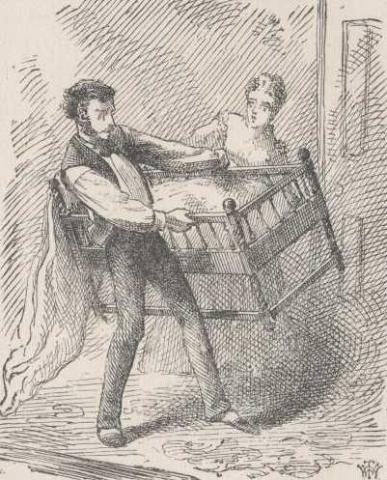


Like the situations in Twain's other McWilliamses stories, this one establishes a situation that lends itself to repetitions of behavior that are but variations upon themselves, as the couple take extraordinary and absurd measures to protect the health of their children, the ailing Penelope and their baby, moving the crib in and out of the nursery, nearer and farther from the fire in the couple's bedroom fireplace, adjusting the temperature of their room up and down, dismissing and recalling the nurse, and Caroline's awakening Mortimer from his sleep to carry out a series of absurd actions related to her nearly hysterical concern for their children. Through such repetition, both in this story and in the other two of the series, Twain extends the narratives' opportunities for humorous treatment, the humor resulting as much from situations involving such repetition of actions as from the opposing traits of the couple's characters.
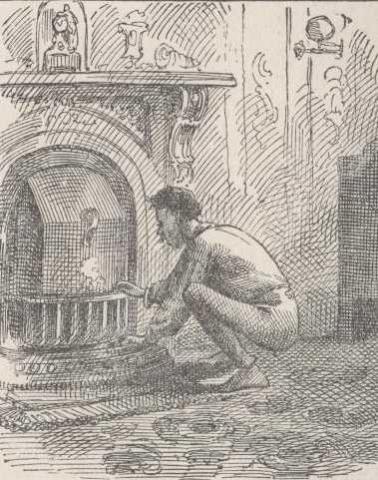


During the course of the story, Twain employs a number of techniques, many of which are also used in his other McWilliamses stories:


Irony and exaggeration: In response to Caroline's refusal to concede the validity of his logic that the pine wood stick that Penelope chews is not of any nutritional or medicinal value, Mortimer says, “Say no more, my dear. I now see the force of your reasoning, and I will go and order two or three cords of the best pine wood to-day.”


Simile: “sleeps like a graven image”


Comparison: “you know no more what you are talking about than the child unborn”


Misdirected concern: Caroline is more concerned about the condition of her furniture and the family's cat than she is that of Mortimer.


Irony: Caroline insists that Mortimer sleep, letting her take care of Penelope and the baby, but she keeps waking him to ask that he undertake another useless task


Redundancy: “I did not finish, because I was interrupted.”


Irony, through impossibility: “he must come, dead or alive.”


Irony through motive: “Very few married men have such an experience as McWilliams's and so the author of this book thought that maybe the novelty of it would give it a passing interest to the reader.”


Situational irony: Penelope's condition is not the result of the membranous croup, after all, the doctor determines, but of her having swallowed “a bit of pine,” from which she “got some little slivers in her throat.”


“Mrs. McWilliams and the Lightning”


My personal favorite of the three, “Mrs. McWilliams and the Lightning,” is based on the wife's fear of lightning. Now known as Evangeline, Mrs. McWilliams awakens her sleeping husband with her panicked shouts of “Mortimer! Mortimer!”


The story makes good on Mortimer's claims, at the outset of the narrative, that his wife's “fear of lightning . . . . is something pitiful to see.”


As in the previous McWilliamses story, the wife is emotional, superstitious, argumentative, and gullible, while Mortimer is rational, put-upon, long-suffering, and henpecked. Only the name of the wife differs in regard to the characters; children are mentioned, but they play no substantial part in the plot.


Evangeline, who does her own share of arguing, all Mortimer seems to do, in response to her claims and her concerns is to “argue it, and argue it, and argue it!” Of course, in doing so, from a logical point of view, he is correct. He is right, for example, that a man cannot “be ashamed when he is asleep.” He is right that swearing does not cause lightning, and he is right that saying “confound it” is not swearing. He is right that ;light does not attract lightning. He is right that not having said his prayers does not cause lightning—or, for that matter, the past occurrences of earthquake and yellow fever that Evangeline blames on his swearing. He is right that his standing in front of their fireplace cannot result in lightning. Nevertheless, his reasoning does not win the argument; Evangeline remains persuaded, because of her readings of esoteric texts, that her husband is wrong and that his behavior is, in effect, a lightning rod that could bring destruction down on them both.


Evangeline's retorts to Mortimer's rational appeals show the tactics she uses to manage and subdue her husband; she charges him, directly or indirectly, with shame, carelessness, recklessness, profligacy, argumentativeness, irreverence, irrationality, and willful ignorance. Although it may be that he does not accept the validity or justice of such criticisms, Mortimer seems more concerned with allaying Evangeline's fears than with winning his argument, which suggests that he loves her, despite her eccentricity, just as her expressions of concern for him and their children implies her devotion to him and their family.


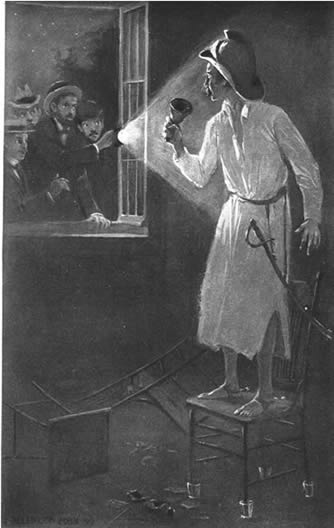
Another source of the humor in this story is Evangeline's attempt to translate an esoteric German text that is clearly incomprehensible to her (and to Mortimer). Believing the book to offer guidance concerning how to deflect lightning, she orders Mortimer to outfit himself in metal objects: his fireman's helmet, his military saber, and his spurs, and to ring their dinner bell, all while standing on a chair. The ringing of the bell causes his neighbors to appear, demanding to know “what in the nation is the matter here?”


The story's punchline comes as the neighbors notify Mortimer that the lightning and thunder he and Evangeline have perceived is, in fact, merely the sound and the flashes of the cannon fire celebrating Garfield's nomination for president. Outside, he is told, “It is a beautiful starlight night.” Due to his wife's superstition and fear, Mortimer has become the laughingstock of the neighborhood and appears himself to be superstitious and fearful.


This story also uses repetition ans a means to both extend the humor and to create a variety of humorous effects. However, this time Twain's use of repetition seems more sophisticated, allowing a greater diversity of sources of information that he can use to produce humorous observations and descriptions, such as science, superstition, rationality, emotionalism, religious beliefs, skepticism, pseudoscience, marital relationships, “book-learning,” private vs. public conduct, personal beliefs, and social and political influences.


In the course of the story, Twain uses these specific techniques to effect humor:


Ironic juxtaposition: “a woman . . . could face the very devil himself—or a mouse”


Concealed humor: Twain tucks humorous observations away among seemingly serious statements, the more to surprise his readers.


Mutual foils as the major source of conflict: a rational husband and an hysterical wife


Superstitious beliefs based on books: “all the books say that . . . .”


Mistaking correlation for causation: cursing causes the flash of lightning that immediately follows Mortimer's “swearing”


Verbal irony: “absolutely at the mercy of Providence”


Simile: “as dark as the inside of an infidel”


Repetition: lightning flashes and thunderbolts allow the extension of the humorous situation through variations of wit and humor; additionally, the husband's alleged profanity has caused not only the current thunderstorm but previous occurrences of earthquakes and yellow fever


Situational irony: a superstitious and irrational wife charges her husband with irrationality, and his actions (lying in bed, standing before an “open fireplace,” “swearing,” standing near a window, approaching a door, standing close to a wall, lighting a match, donning his pantaloons, failing to say his prayers, singing, admitting a draft of air into the bedroom, turning on water, failing to order a feather bed) attract lightning 


Categorical absurdity: the wife regards the use of the word “blessed” as an instance of profanity


Personification: lightning is a “marksman”with bad aim, yet


Dubious cause-and-effect relationships: the wife's shutting herself inside the boot-closet with a book causes her husband to enjoy “a moment's peace”


Ridiculous, unnecessary action causes destruction: chasing a cat destroys $400 worth of furniture


Complex process with ludicrous goal results in absurd actions and husband's becoming a laughingstock


Ignorance compounded by arrogance: The McWilliamses' inability to understand a book written in a foreign language results in ad-libbing ridiculous “translations”


Mistaken effects: cannon fire, not storm, causes effects perceived by the McWilliamses as lightning and thunderbolts


Preliminary, apparent punchline trumped by actual, climactic punchline: not only is Mortimer a laughingstock (preliminary, apparent punchline), but he is also mistaken about the apparent cause of the “lightning” (cannon flashes) and thunder (cannon fire) (actual, climactic punchline)


“Mrs. McWilliams and the Burglar Alarm”


In “Mrs. McWilliams and the Burglar Alarm,” Twain uses the same structure of repetition to milk the situation of its humor. Despite the presence of an expensive, sophisticated burglar alarm, burglars repeatedly burglarize their house. Repeated repairs and adjustments to the burglar alarm merely make the situation worse or introduce new problems. First, the alarm fails to prevent burglaries; then, adjusted (a huge gong is added to the contraption), the alarm works too well, awakening the entire household every time the cook starts the day at five o'clock. In fact, it works so well, it literally wakes the dead. Another repair, due to a series of false alarms, results in so many burglaries that the residents no longer respond to the alarm, surrendering the run of the house to the thieves. The burglar alarm company seeks to remedy this problem by replacing the burglar alarm's clock every three months, which is not only expensive (as all the previous repairs have been), but each effort is “always a failure.”


This story features the following uses techniques:


Spurious cause and effect: “we found we had a little cash left over, on account of the plumber not knowing it.”


Irony through contrasting motives: “I was for enlightening the heathen . . . .[the motive sounds noble], for I was always unaccountably down on the heathen somehow” (but it is really base).


Definition: “whenever I want a thing, and Mrs. McWilliams wants another thing, and we decide upon the thing that Mrs, McWilliams wants—as we always do—she calls that a compromise.”


Punchline: The burglars finally steal the burglar alarm itself.


Play on words: “swear at—sear by, I mean.”


Riff on “summer”: “They [alarm firm workers] promised to have the whole thing finished in ten days. They began work, and we left for the summer. They worked a couple of days; then, they left for the summer. After which the burglars moved in, and began their summer vacation.”


Personification: clocks “would take it [the burglar alarm] off again as soon as your back was turned”


Verbal irony: “those things [burglar alarms] are made solely in the interest of the burglars”


What Could Go Wrong?


One theory of humor finds the source of humor in situations in which a character perceives that something is wrong. Obviously, Twain takes this approach in his McWilliamses stories. Being struck by lightning may not be funny, but as Twain shows, being hysterical about the possibility, which is fairly remote, can be hilarious. What's “wrong” isn't the lightning itself (which, in fact, in the story, never actually occurs), but the irrational fear of it and the behavior that such fear produces. “Mrs. McWilliams and the Lightning” is an account of the multiple results of such hysteria. Twain uses the same approach in his other two stories: In “Experience of the McWilliamses with Membranous Croup,” Evangeline is terrified that her daughter and baby may die from the disease, and her fear fuels the story's humorous effects, as she puts Malcolm (and the rest of her household) through its paces in an effort to save her children, who, as the doctor reveals at the end of the tale, never were at risk, since neither Penelope nor her sibling actually had the membranous croup or any other sickness. “Mrs. McWilliams and the Burglar Alarm” uses the same formula, but, this time, it is an object, more than the characters of the story, that goes wrong, the burglar alarm failing to work at all, working too well, or working at inappropriate times. If such an approach works for Twain, it could work for others, provided, of course, they have Twain's considerable, perhaps unparalleled, gifts as a humorist.


Thursday, July 2, 2020

Establishing and Structuring Humorous Novels

Copyright 2020 by Gary L. Pullman


For me, Mark Twain is the most humorous humorist that ever wrote humor.


I think part of the reason that he's humorous is that he constructs a plot that provides a sense of progress and a series of burlesques unified through character, setting, and situation. Often, the titles of his books themselves identify or suggest the conceit: A Connecticut Yankee in King Arthur's Court, Life on the Mississippi, A Tramp Abroad.


For example, the idea for A Connecticut Yankee in King Arthur's Court (traveling back in time to set up a continuous contrast between the medieval and the modern) establishes the basis for sustained, continuous humor, satire, parody, and burlesque.


In addition (Twain usually progresses from general to specific), the chapters themselves of his novels suggest the same structure and the same elements: “Camelot,” “King Arthur's Court,” “Knights of the Round Table” . . . “The Eclipse,” “Merlin's Tower,” . . . “The Tournament” . . . .

Internally, each chapter is also structured:

Chapter I (Camelot): the countryside is described; a girl appears; the protagonist approaches the town; a detailed description of the town and several of its residents is presented; Chapter II (King Arthur's Court): The protagonist exchanges dialogue with an old man; the protagonist exchanges dialogue with a page; the protagonist and the page arrive at Sir Kay's castle; the narrator presents a philosophical conclusion (i. e., one of the novel's themes).


This threefold structure indicates, with increasing specificity, the sense of progress, which unifies the story while introducing topics for humor. By the time readers finish the story, the foibles of the novel's characters and the folly of their times (and their view of the world) will have been thoroughly examined, criticized, and lampooned.


In the actual paragraphs of the story, Twain uses many devices to spoof the targets of his humor, including mistaking Camelot for an “asylum”; similes (“as lonesome as Sundays,” “made him look like a forked carrot”); incongruous diction (“”her own merits in . . . respect” to being “a spectacle”); derisive adjectives (“windowless,” “wilderness of thatched cabins,” “crooked alleys,” “unpaved,” “troops of dogs and nude children,” “reeking wallow”); contrast (“a noble cavalcade . . . glorious” vs. “the muck and swine and naked brats”); evaluation (the old man's use of Middle English confirms his status, in the protagonist's eyes, as an inmate of the 'asylum”); personification (“comfort his very liver,” “let that shudder its way home”); metaphor (“he was pretty enough to frame”); incongruous description (“shrimp-colored tights”); and a play on words (“”he informed me he was a page,” but, the narrator says, “you ain't more than a paragraph”).


Twain's technique could be used to set up a variety of other opportunities for humor through such contrasts and conflicts between opposing types of characters:
  • A genius among fools
  • Hercules among the Amazons
  • The experiences that occasion various proverbs
  • A sane man on a ship of fools


Sunday, October 9, 2011

How To Write Hilarious Humor: An Analysis of Professional Comedians' (and Comediennes') Techniques to Tickle the Funny Bone


Chapter 4: “Kiss ‘Em, Kick ‘Em, and Kiss ‘Em,” Climactic Sequences, and Tone

Copyright 2011 by Gary L. Pullman


If, as a humorist, you’re going to trash someone--a friend (or future former friend) or a family member (before he or she has disowned you forever), perhaps--you don’t want to look, to your reader, like the shark that you are. You want to look like a nice guy or gal. How do you accomplish this miraculous feat?

In trashing her deceased mother, in the “Oh, Mother!” chapter of her book, Radner faced this very problem. Her solution? Prior to the trashing, say some nice things about her target. Use the “kiss ‘em, kick ‘em, kiss ‘em” strategy, wherein one lauds the soon-to-be butt of one’s jokes, then savages him or her, and then again praises the poor soul. Radner devotes two, albeit admittedly short, paragraphs to praising her mother:

It’s my contention that the things you remember about your childhood govern the way you raise your own children. Even though my other died when I was thirteen, I find myself constantly remembering the little things she did for me as I spend time with my daughter.

Kindness was my mother’s finest attribute; cooking was her downfall. Luckily, I was not a picky eater. Most of the things she cooked for me I found delicious.
Her chapter’s title, “Oh, Mother!,” by the way, is a play on words, recalling the exasperated cry, “Oh, brother!,” and sets the tone of the chapter--the narrator’s expression, mild and humorous, though it may be, of her exasperation with her mother’s lack of cooking “talent.”

Now that Radner has set up the chapter’s basic situation, she, through her narrator, presents the standard humorous examples to support and develop the chapter’s topic (her mother’s abominable cooking):

. . . Her most successful culinary creation (and my all-time favorite) was spaghetti mixed with ketchup and a semi-melted lump of butter. My second favorite was what I called Campbelled rice. This paired instant rice with Campbell’s Vegetarian Vegetable soup. Not only was it delicious, it was also educational (if not entirely sanitary), as I would spell out different words on the kitchen table with the gummy letters.
A technique for creating humor, seen in this paragraph, as previously in Radner’s book, is to mix categories, such as cuisine and education. The unlikely pairing is not only surprising, but amusing, for it brings together a ludicrous association that, despite its absurdity, nevertheless, in some way, seems to make sense. Radner’s use of this technique also taps into the familiar, because many adults are likely to remember playing with alphabet-shaped rice or pasta letters in their soup, just as Radner describes herself, as a girl, of having done. Absurdity mixes with familiarity to get a laugh. She then extends the humor by describing how her mother extended any leftovers from this meal to create another dish, employing, once again, a strange mixture of two disparate items, “soup,” a serving of food, and “Spackle,” a sealing compound used in construction:

If there was any Campbelled rice left the next day, the mixture would be poured into tomato soup, thus creating yet another unique variation: Campbelled tomato rice paste. It was midway between soup and Spackle.
Radner’s next paragraph begins with a list of items in a series which have no apparent relationship to one another. However, a link between these disparate items is formed by Radner’s identification of them as her “mother’s three most spectacular failures”: “My mother’s three most spectacular failures involved a can or corn, a duck, and matzo balls.” Having created a Lucy Ricardo-like caricature of her mother as an inept cook and having cited a couple of previous examples of her mother’s culinary incompetence, Radner has interested her readers in learning more about the poor woman’s “culinary failures.” Because of the nature of comedy, in which humorous anecdotes or jokes move steadily toward a crescendo, or climax, of mirth, readers also expect that the quips and gags will be funnier than the previous ones were, although these newer ones will be topped, in turn, by even funnier ones, until, at last, the climax of the series is reached.

Sure enough, Radner’s mother doesn’t disappoint, for she next turns a can of corn into a bomb; cooks inedible, rubbery matzo balls; and reduces the duck, which she seeks to cook as if it is chicken, to an unrecognizable, gelatinous mass that even the daughter, who is “not a picky eater,” refuses to sample, in any form (whether as a roast duck, a salad ingredient, or a sandwich filler). In detailing these “culinary failures,” Radner spices her descriptions with more than a dash of hyperbole:

I don’t know what prompted her to put a closed can of Niblets into the searing oven; I just remember the explosion. . . . I was in charge of picking bits of corn off the floor while she climbed the ladder and tackled the ceiling.
[Trying to consume the matzo balls] was like eating dried Silly Putty. We were fearful of breaking the garbage disposal, so the leaden bits of dough were finally tossed in the trash. . . .
I remember her taking the duck [that the narrator’s mother had prepared as she’d supposed a chicken should be cooked] out of the oven and encountering a sea of grease that in my brief life I had never seen emanate from a chicken. It was so slimy that as my mother served it, the poor bird almost slid off the plate.

Having “kicked” her mother--or a caricature of her mother--Radner now has her narrator “kiss” her again, as the chapter comes to a close, in a paragraph which, for humorous books, is unusually long, and which is followed by a shorter, final paragraph that rounds out the chapter. The longer paragraph begins, “Along with my mother’s lack of cooking talent, I also remember her remarkable personality. I remember the light in her eyes whenever she saw me. I remember her kind voice and her forgiving, patient nature. . . .”

Conclusion

Sometimes, a humorist may savage a friend or family member--or, actually, a caricature of such a person. To prevent alienating him- or herself from the reader, the humorist should adopt the “kick ‘em, kiss ‘em, kiss ‘em” strategy of first praising the victim-to-be, before verbally assaulting him or her with outlandish exaggerations of a defect, real or imagined, and then, once again, lauding the savaged party before concluding the chapter with a short, often single-sentence expression of appreciation for his or her overwhelmingly positive personality traits and behavior patterns, such as Radner does in the closure to her “Oh, Mother!” chapter: “Cooking aside, I only hope I’m half as good a mother to my daughter as my mother was to me.” This concluding comment will leave readers with an “awwwwwww” reaction, rather than a feeling of disdain for someone who would savage a friend or family member (even a caricaturized version) simply to get a laugh. In this chapter, Radner uses several devices she’s used before, including exaggeration, or hyperbole; ludicrous examples; conflated, absurd comparisons; and climactic sequences in which lesser jokes and gags are followed by greater jokes and gags. Her title, “Oh, Mother!,” is a play on words, recalling the exasperated cry, “Oh, brother!,” and sets the tone of the chapter--the narrator’s expression, mild and humorous, though it may be, of her exasperation with her mother’s lack of cooking “talent.”


Next: Chapter 5: Juvenalian Satire

Friday, December 4, 2009

Humorous Techniques: Erma Bombeck

Copyright 2009 by Gary L. Pullman

Before we consider specific examples of humorists’ writings, let’s summarize the principles and techniques that we’ve gleaned from our review of the history of comedy and humor and those who have perfected these forms of entertainment.

The Old Comedy of ancient Greece involved bawdy humor, humorous references to body parts and bodily processes, social criticism, puns and wordplay, and the satirical parody of famous men, such as the philosopher Socrates. Middle Comedy and New Comedy replaced the coarse humor of Old Comedy with a comedy of manners and with romantic intrigue that ended in marriage, and established many stock characters. In the fabliaux of the Middle Ages, earthy, even obscene and pornographic, humor returned, in poetic, rather than dramatic, form, as did the biting satire against authority and aristocratic figures, especially hypocritical and sanctimonious clergymen. Modern history’s contribution to comedy and humor takes the form, primarily, of the situation comedy, in which recurring stock characters are involved in amusing situations. Whether two, three, or four acts in length, such comedies tend to follow a circular pattern, offering a twist, at their ends, on the situations and themes with which they began.

In general, as Harman and Holman observe in A Handbook to Literature, 10th edition, humor results from a display of “incongruity of speech, action, or character. The incongruity may be verbal, as with a play on words; or bodily, as when stilts are used; or satirical, as when the effect depends upon the beholder’s ability to perceive the discrepancy between fact and pretense exhibited by a braggart. . . . Viewed in another sense, comedy may be considered to deal with people in their human state, restrained and often made ridiculous by their limitations, faults, bodily functions, and animal nature.”

Twain’s humor often offers social criticism as well as burlesque, satire, irony, and parody, which unifies his work and elevates it above mere humor for humor’s sake. His works are also unified through travel, cases of mistaken identity, the commission and solving of a crime, specific historical periods as settings, the use of recurring characters, and the fictionalization of personal experience. Erma Bombeck’s humorous essays are often made coherent by offering comments upon various aspects of an analogy, explicit or implicit, that she draws between one realm of human experience and another or between a realm of human experience and a natural order or phenomenon, as when she compares psychology to ethnology, motherhood to prostitution, or family activities to sadomasochistic bondage and discipline pursuits. Humorous essays must also adhere to a central point of view and to a dominant tone; indeed, the point of view may comprise a refutation of a theological or a philosophical proposition, as Voltaire’s Candide and the Marquis de Sade’s Justine do.

In addition to the topics and themes of comedy and humor that ancient Greek playwrights identified, modern humorists have added process analysis, or “how-to” humor; verbal duels between friendly or romantically involved, but diametrically opposed, characters who are confined to close quarters with one another; ironic fables; teen angst; and grotesque or absurd situations. The more avant-garde humorists reveal the surreal undercurrents that are often active just below the conscious level of the modern mind and its mindset.

Now that we have considered the principles and techniques that apply in general to comedy and humor, let’s look at those which such famous humorists as Erma Bombeck and Mark Twain employ in their work.

How does a writer go about starting a humorous essay? How does he or she introduce the essay’s topic, capture the reader’s interest, and establish his or her tone? Once begun, how does a humorist unify his or her thoughts and humor, and how does he or she structure the essay?

Many humorous essays begin with a confession or a claim, a statement that piques the reader’s interest and lays the foundation for the rest of the piece. These opening sentences are short. Sometimes, they are pithy as well. Ideally, they are themselves funny, although not all of them are. Here is an example, the opening sentences of Erma Bombeck’s “Dieting Is a Losing Battle,” published March 21, 1978:


It’s no use for me to diet. I know that now.

With these sentences, Bombeck:

  • Announces her topic (dieting)
  • Suggests her attitude toward her topic (dieting is useless)
  • Implies that she has learned a lesson from personal experience (“I know that now.”)
  • Suggests a plaintive, perhaps humble, and defeated tone.

As we track through Bombeck’s essay, we note that she uses short sentences to form short paragraphs. In addition, she writes in a colloquial, or informal, style that tends to employ short words. Many of her sentences are actually fragments that begin with “And” or “But,” a technique that prevents compound sentences from becoming longer than they would be were they written as correct grammar dictates. She uses contractions, such as “I’m” instead of “I am.” Except for a few necessary functional sentences, such as those which introduce topics, provide transitions, or set up a situation as a way of introducing a punch line, each and every sentence--or, at the very least, each and every paragraph--of her essay contains a humorous phrase, creates a funny situation, or makes a joke.

Having piqued her readers’ interest and established her topic, tone, and point of view, Bombeck next introduces a pair of personifications, as she lets her body do the talking; her knees whisper, and her mouth speaks:

All those years when my knees rubbing together whispered “no, no”but there is a
“yes, yes” in my mouth, I fought the battle.

These personifications indicate body parts (knees and mouth) that are in conflict with one another, and the end of the sentence introduces the analogy upon which Bombeck will develop her essay: dieting = battle, which ties in with the essay’s title, “Dieting Is a Losing Battle.”

She next offers an example of her persistence in fighting her “losing battle”; in doing so, she introduces an element of the absurd, exaggerating her weekly weight problem by locating her loss of weight in her “neck” and her “bust”:

All those years when I lost 10 pounds every Monday (five in my neck and five in my bust), I hung in there.

By repeating the phrase “All those years” and a variant of “I hung in there” (“I gave it my all”), Bombeck continues to suggest her persistence, the humor in the sentence that follows stemming from an absurd metaphor that equates her embracing of “cottage cheese” to a “religion”:
All those years when I embraced cottage cheese as a formal religion, I gave it my all.

Having provided her reader with two examples of her persistent battle, she reiterates her essay’s theme: she is losing the battle.

But after yesterday, I have to admit, I’m beaten. I’m fighting the battle alone.

She says “It started in the morning.” By “it,” she means her loss of her battle to lose weight. Her placing of her hand over her heart and her substitution of the phrase “allegiance to hunger” for “to the flag of the United States” is humorous because the cause to which she allies herself, hunger, is a natural and instinctive drive that needs no allegiance and because such an “allegiance” pales in significance to confessing loyalty to one’s country. Humor often works in this manner, by substituting the trivial for the important. Her “allegiance to hunger,” rather than to dieting, represents a turning point; now that she has decided to give in to “hunger,” she can feel “virtuous” in defying her diet:

It started in the morning when I faced the refrigerator with my hand over my heart and once again pledged allegiance to hunger. I poured myself half a glass of tomato juice mixed with half a glass of buttermilk and tossed it down. I felt virtuous.

Although this is a short paragraph, it is longer than most of the others in Bombeck’s essay. Therefore, it highlights itself. It is important to her theme, because it sets up Bombeck’s rebellion against dieting, something that she equates, implicitly (by placing her hand on her heart and swearing “allegiance to hunger”) with patriotism; it is an act not unlike the founding fathers’ revolt against the tyranny of England. This analogy makes her essay’s title more significant, for the “battle” of which it speaks seems now to be associated with the Revolutionary War.

It seems that Bombeck will suggest that her “allegiance to hunger” rather than to dieting is a courageous and honorable one, akin to the colonists’ revolt against the British crown, but, instead of extending this analogy, she abandons it, the remainder of her essay exemplifying how she continues to add to and enhance the simple meal that she’s prepared for dinner and blames her husband for her having done so (to punish him for being late, she adds “whipped potatoes to the meal,” and to distract him from “the small main course,” she prepares “a robust appetizer,” and then accuses him of not caring “about other people at all” or “how they look”).

Although Bombeck, in abandoning the implicit metaphor she creates by likening her “allegiance to hunger” to the colonists’ revolt against British tyranny as a stand-in for the tyranny, as it were, of dieting, her essay, having pulled readers in, continues to amuse, which shows that, once a humorous essay gets started, it can proceed, even if it unexpectedly and irrationally changes direction in midstream. After all, readers are looking for humor, not logic. However, an essay that does both--amuses and stays true to its implicit rationale--would give readers the best of both possibilities and, arguably, would, therefore, be of superior quality. Bombeck is a master at setting up the humorous essay. We can learn a lot from her techniques for doing so. As we saw, many humorous essays begin with a confession or a claim, a statement that piques the reader’s interest and lays the foundation for the rest of the piece, and Bombeck is adroit at such beginnings.

However, she also uses plenty of other ways to open her essays.

One is the surprising statement. She opens “Hello, Young Mothers” with the declaration that “Once. . . just once. . . I’d like to be dressed for an emergency.” Since one does not dress for “an emergency” and because, even, if one were wont to do so, an emergency, by its very nature, would not allow one the time (or clarity of mind) to pick out an outfit to wear for the occasion. Therefore, her expressed desire to dress for crises is as unexpected to readers as it is ludicrous. By surprising her readers with such an odd and irrational statement, Bombeck makes them want to read further. Therefore, the sentence is an effective opener.

“Birds, Bees, and Guppies” opens with a declaration to which all parents would be likely to assent, although it addresses a topic that they’d probably be just as happy to avoid altogether, were it possible to do so: “The sex education of a child is pretty important. None of us wants to blow it.” Since her comment addresses a sensitive, potentially embarrassing topic, readers may read on to see whether the famous humorist can transform her subject matter into something more lighthearted than somber. Perhaps humor will put the matter of “the sex education of a child” into perspective. By suggesting that she can use her humor to cut such a serious subject down to size, so to speak, Bombeck reassures parents who may soon have to instruct their own children in this difficult subject.

In “Outgrowing Naps,” Bombeck resorts to an effective strategy for broaching her essay’s topic while hooking her readers: without humor or fanfare, she simply states the situation that her essay will proceed to develop: “A group of young mothers huddled around the kiddie pool the other day discussing children’s naps.” She tries the same gambit for “How to Communicate with Toddlers,” writing, “A father in Champagne, Illinois, is enquiring how to communicate with toddlers.” Her reputation as a humorist alone promises that something funny will come of this situation. For those who have not yet garnered such a reputation, a different, more obviously humorous approach might be a better way to start an essay; Bombeck uses this approach to initiate “I’m-Not-Going Syndrome”: “I’m at the age of my life where every time I buy something of any value, I have visions of my kids marking it down to $2 at a garage sale.”

Bombeck also uses a rhetorical question, on occasion, to start an essay. Often, in doing so, she puts the question into an invented character’s mouth, as though someone other than she were posing the query. “Disposable Diapers” opens this way: “The question being asked by baby boomers isn’t, ‘Is there life after throwaway diapers are abolished?’ but, ‘Is that life worth living?’” “Alaska Cruise and Smoked Salmon” opens in a similar manner: “Last spring, my husband looked up from the travel section of the newspaper and said, ‘Have you ever thought of what it would be like to catch and smoke your own salmon’?” More rarely, Bombeck herself, or her stand-in persona, will ask the question directly, as she does in “The Instead-of Cookbook”: “Why doesn’t someone write a cookbook for the suburban woman with one car that is used by her husband?”

She also starts essays with dialogue which is often intriguing in itself or becomes so within a few lines. “I don’t want to go to grandma’s” (“I Don’t Want to Go to Grandma’s”), “You don’t love me!” (“I Loved You Enough to. . . “), and “‘Hey, if you write a column for a newspaper,’ said the voice on the telephone, ‘how come you don’t tell women how to get stains out of their stainless steel sinks?’” (“Household Hint”).

Some of her essays begin with a complaint: “I don’t know what my husband thinks I’m made of!” (“Soap Operas”); “There is no delicate way to say it. My social life is somewhere to the right of a sedated parrot” (“My Social Life”), Occasionally, a sentence will serve as a sort of straight man so that the one that follows it can deliver a humorous punch line. Bombeck opens chapter three of All I Know About Animal Behavior I Learned in Loehman’s Dressing Room with this technique, with her use of exaggeration effecting the humor: “I have come up with a wonderful solution to end all wars. Let men give directions on how to get there.” She uses the same approach to open chapter fifteen of the same book, again using exaggeration to deliver the humor: “I was never caught up in the jogging/running movement that swept the country in the seventies and eighties. Face it, I call a cab to go to the mailbox.” More rarely, a sentence that itself contains the setup for the joke it contains is used to open a chapter or an essay.

The first half of such a sentence sets up the joke, which follows in the second half of the sentence. Chapter eight of All I Know About Animal Behavior I Learned in Loehman’s Dressing Room begins with such a sentence: “Compared to the IRS when they cash your check, the cheetah is standing still.”

Like her books, Bombeck’s essays are often built upon an analogy, and she uses familiar figures of speech--metaphors, personifications--in unexpected, and, therefore, humorous ways to make her points as she presents the central “argument” that her essay’s title suggests. All I Know About Animal Behavior I Learned in Loehmann’s Dressing Room equates “animal behavior” with human conduct, suggesting that by using the principles and techniques of ethnology, she can better understand the behavior of her fellow human beings. In other words, her book is based upon the analogy that “people are animals.” To maintain this analogy, she starts each chapter with a tongue-in-cheek epigraph from a spurious ethnological treatise. Frequently, this epigraph creates a point of departure for Bombeck’s comments concerning a specific human habit, practice, or behavior.

For example, chapter seven of her book deals with human packrats. She opens the
chapter with this epigraph:

Many animals tend to store things. The bowerbirds of Australia and New Guinea
decorate their courting grounds with everything from beetle wings to pilfered
car keys. They will hoard anything. After mating, the male splits and the female
raises the brood by herself.

This counterfeit quotation provides the jumping-off point for her wry observations on concerning her need to collect everything and to part with nothing:

Lest you confuse me with some amateur collector, I must tell you there are levels of savers. There’s the common garden variety who hoard rubber bands like they’re never going to see another one. And the bread tie disciples who don’t have a clue what they can use them for, and of course the proverbial plastic margarine container freaks who use them to store leftovers that they are going to throw away in three day. They’re novices.

No, I’m talking about a woman who still has her report cards from the third grade. . . food coupons that have expired. . . Single earrings. . . boots with a hole in one of them. . . and a wildlife calendar from 1987 because February shows a bear in a party hat.

This same pattern is repeated throughout the book, as Bombeck offers her take on courtship, reproduction, potty training, eating, and other activities, showing how human conduct parallels animal behavior and suggesting that it is not necessary to go, as Jane Goodall went, into the African veldt, to study the human species; it’s enough to be a wife and mother.

Like many other humorists, Bombeck’s books, if not her essays, have extremely long titles. Such titles are themselves ludicrous, since they fly in the face of the conventional requirement of publishers and the natural tendency of writers to keep their titles as short as possible. A list of some of her works makes this technique clear:

  • Just Wait Till you Have Children of Your Own!”
  • Lost Everything in the Post-Natal Depression
  • The Grass Is Always Greener Over the Septic Tank
  • If Life Is a Bowl of Cherries, What Am I Doing in the Pits
  • Motherhood: The Second Oldest Profession
  • Family: The Ties That Bind. . . and Gag!
  • I Want to Grow Hair, I Want to Grow Up, I Want to Go to Boise
  • When You Look Like Your Passport Photo, It’s Time to Go Home
  • A Marriage Made in Heaven. . . Or Too Tired for an Affair
  • All I Know About Animal Behavior I Learned in Loehmann’s Dressing Room

Next: Mark Twain